Today, Radio Shack filed for Chapter 11 bankruptcy. Let me explain why I care about that.
Part of it is unquestionably nostalgia. When I was - let's see, about 16 - my mom said that I needed to start applying to scholarship programs for college. I must have written about 100 essays on all kinds of crazy topics, like agriculture or beekeeping. But one of the essays I was actually kind of interested in writing was about electronics. It went to a little organization called the Tandy scholarship - and I won. I received $1000 for college, which was awesome. But even better - although I didn't realize it at the time - it came with a job offer: come work for Radio Shack in the summers. As it happened, my parents also wanted me to have a summer job. So, the summer between junior and senior years of high school, I found myself driving to a Radio Shack owned by a guy named Chuck in a strip mall in Jacksonville.
Now, Chuck was just a really stand-up guy. He was the sort of dude that rolled his dress shirts up to the bicep. He shot straight with everybody - customers and staff. And he really liked me. Maybe he liked me because I liked electronics. Maybe it's because I was a good, quiet employee. I did the things his other employees wouldn't do, like stock shelves. You see, Radio Shack was mostly commission in those days (maybe it still is, I don't know). All the other people working there just wanted to sell big screen TVs and computers. I remember one guy I worked with, an Italian guy in probably his late 30s, who was one of the best salesmen I'd ever met. He chain smoked, and he would stand outside on the sidewalk holding the door open, cigarette in one hand. If anybody got near the store, he'd throw the cigarette on the ground, hold the door open for them, say "How's it going, boss?", and follow them into the store. From that point on he would never let you go. The guy was good. I watched him sell refrigerators to Eskimos, if you get my drift. And I didn't care about any of that. I was there just to make my parents happy. The money was a nice perk.
I learned a lot from working in that store: how to be nice to your coworkers, how to dress nice every day, the value of a dollar. But the most important lesson I learned was this: you can build stuff, and even more importantly, you can take it apart. I remember that, once a year during the summer, Chuck would have what he called a "tent sale". You see, one of the great - and terrible - things about Radio Shack was that they would take anything back, anytime. And people knew it. We used to call it "Rental Shack". One summer while I was there, at the beginning of the summer this construction crew came in. They bought all kinds of stuff, including a bunch of expensive walkie talkies. At the end of the summer, they came back in with them, all crusted with dirt, and said, with a straight face, that they didn't like them very much. Chuck took 'em back. Anyway, at the tent sale, we would sell all that stuff: the stuff so broken that Radio Shack headquarters didn't even want it. Chuck's store was the district store (Chuck was the district manager in addition to the store manager), and he would collect all this stuff and put it out for pennies on the dollar. Mostly it was there to attract people into the store. When that sale happened, I would spend half that week's paycheck on stuff. I remember I bought a whole stack of semi-functional electronic calculators one time. One of them had a tiny solar panel, and I took it apart and wired up that solar panel to a meter to see how much electricity it put out (not much). I don't know that I ever learned anything all that monumental. All the real learning happened later, in college. But what I learned was more important: that you could take things apart. It was OK.
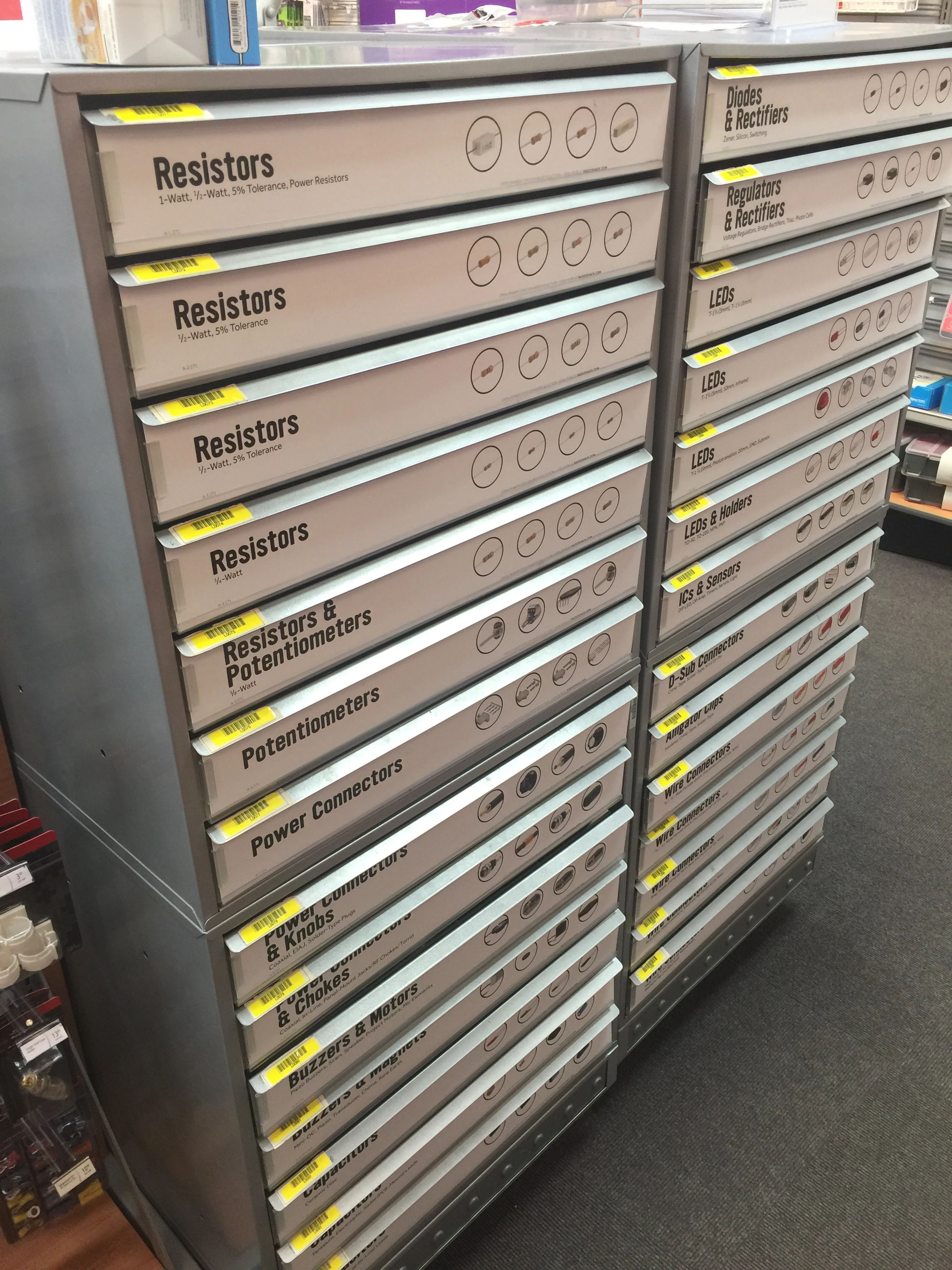
You see, that's what Radio Shack represents - or used to. And it's still there, if you go look, behind all the cell phones and XBox controllers - the old Radio Shack. Arduinos, weird batteries, multimeters, soldering irons - buried in the back. Most of the time the people working there don't even know what they are. But they are a link to something important and valuable, a time when it was explicitly American to build stuff, when knowing how to work a soldering iron was cool. Now, I'm not saying that is gone. Others have taken up the mantle to some extent: hacker collectives, the Maker movement. But Radio Shack was unique: it was the only place that somebody in, say, Redmond, Oregon could go and buy a transistor, or a resistor. And that's important. It's all well and good to buy stuff from Amazon, that's cool. But here's the thing: I never *explore* at Amazon. I hardly ever go there to buy things I didn't already know I wanted or needed. Radio Shack was, for a kid, like the public library - a place to go *learn what you didn't know you wanted to learn*.
I'll miss Radio Shack. And I wonder what Chuck is up to these days.