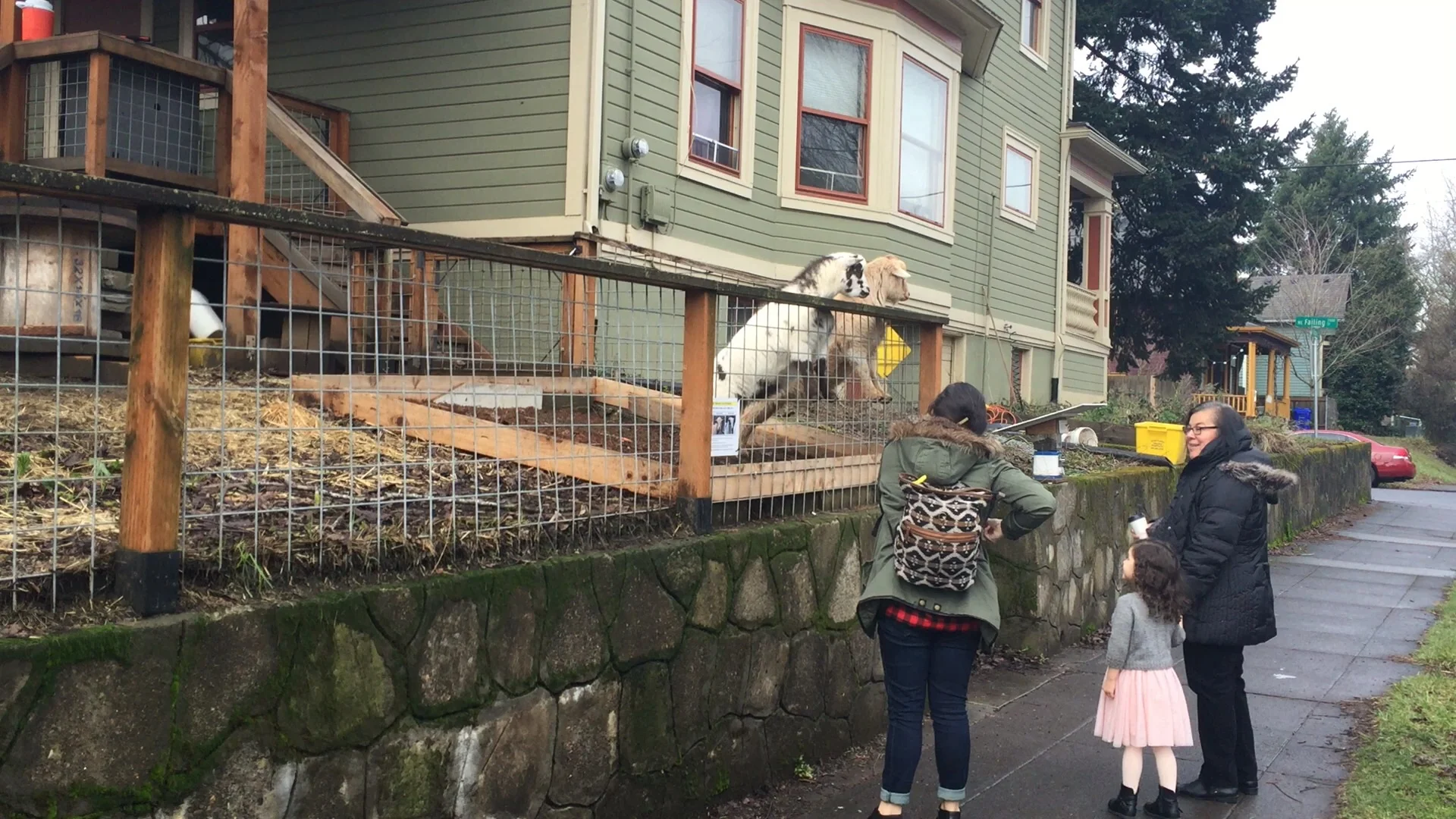
As part of a class I'm taking on Animal Behavior at Mt. Hood Community College, today I had to observe animals and complete an ethogram, basically a summary of their behavior. I chose this urban goat "ranch" in NE Portland; three goats that live in this backyard. I thought the ethogram was really interesting, so today's post is just that!
Ethogram for Nigerian Dwarf Goats (Capra aegagrus hircus)
Observed at the “ZZZ Goat Ranch” (a house in NE Portland with a backyard) on 1/15/2016 from approximately 11am to approximately 12:30 am.
There were 3 goats, clearly domesticated, in a house backyard with a clear wire fence.
Type of Behavior: Locomotor Acts
In the hour and a half that I spent observing, the goats spent most of the time not really moving at all. They would graze in one spot for about 3-5 minutes at least, then move at most 5 feet or so. At some point, the goats noticed the arrival of a human family and that caused them to move. They use an unhurried gait which is cross-gaited, that is, they will move the front right, then back left, then front left, then front right.
They seem to have difficult bending the legs. At one point I noted a goat attempting to reach something under the deck and he had difficulty getting his body underneath the space.
They seem at first not very agile, but it is deceiving: I noted them placing both front hooves into a fence to reach up and over the fence.
In general, they won’t reposition their body and legs until it is absolutely necessary, using their very flexible and long necks to reach whatever they wish.
Type of Behavior: Foraging Patterns
I watched the goats eat off of some felled logs. They use their strong jaws to pull at the strips of bark with tugging motions that involved the whole body. They then also nibble using the front teeth, which extend, and a long and agile tongue.
The 3 goats stayed very close to each other (within 5 feet) but not touching or eating the same piece of food, and largely ignore each other even when they are very close. They did not fight or compete for food.
At some point a family approached. The goats are obviously conditioned to expect food from human observers. There is a pay-for-food station nearby and the goats were clearly expecting food, which they received. When eating the small chunks of goat food, they extend the tongue long to slurp up the individual pellets.
As foragers they are definitely grazers; they stay upright and extend the neck down to the ground to eat. They will eat a good portion, then they will raise the neck, and chew the cud by moving the lower jaw back and forth laterally against the top jaw. I watched at least one instance of them swallowing and then regurgitating cud as well.
Type of Behavior: Maintenance Activities
Despite it being quite a cold day (40-42 degrees F), the goats made no move to hide, or take shelter, instead standing exposed. They have a long and thick coat.
They preen occasionally, and use their long necks and long tongues to move the mouth almost to the entire rear of the body, pulling at the fur with the front teeth with the long elastic almost giraffe-like neck.
Ears are kept projected from the body, listening for sounds. They track movement by moving the entire head, but the impression I received was that they have poor eyesight and seem to be more keen on sound. The ears move independently from the head and each other and track the sound.
They will occasionally shimmy or shake the entire head and upper torso; it’s not clear why but it resembled, to me, the motion of a dog shaking off water.
Type of Behavior: Specialized Behavior
I did not observe the goats long enough to see anything particular, except for the motion to chew the cud I described earlier, and their specialized interactions with the humans, as domesticated animals.
Questions about Behavior
Obviously, with domesticated animals, I’m always curious as to which behaviors I observed are “native” to the species and which come from domestication. I noticed two almost entirely separate behavior patterns: before the human family approached, and in interacting with the family. Was the behavior I noted before the family arrived more indicative of native behavior?
What is their behavior like when resting? I noticed that they really preferred a standing posture. Do they sleep standing up? Do they continue to preen when resting?
What is their eyesight really like? They gave an impression of poor eyesight: seeming to stare blankly, for example, but tracking the source of sounds. Is that a mistaken impression?
What would they be like in a larger, or non-enclosed space? Would they range over a wide area? Would they separate or stay close together as they did here?