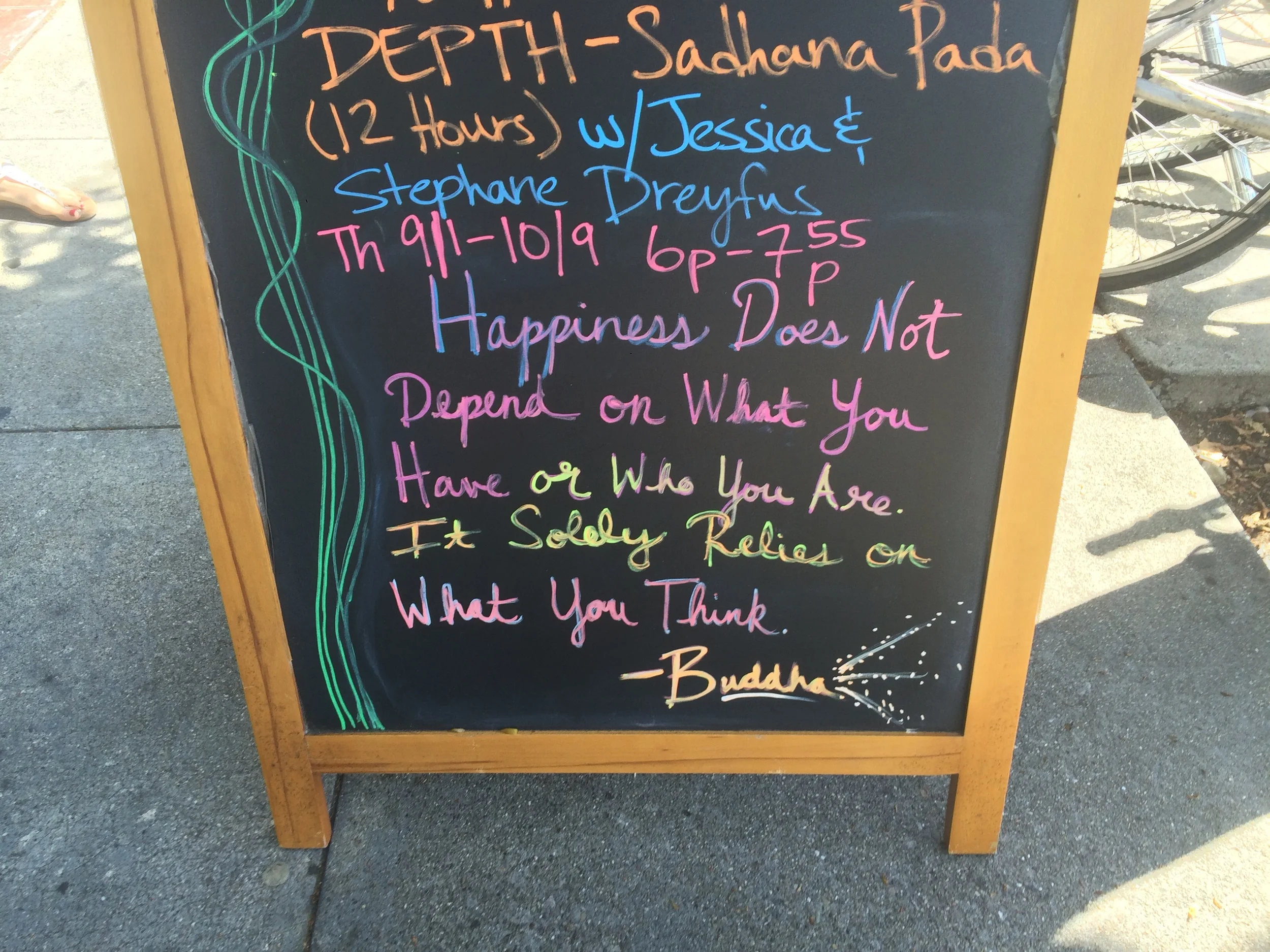
Today I’d like to talk about stress. Ever since I’ve gotten back into town, it’s a topic that’s been on my mind. I am happy to be back in San Francisco. It’s a fun and vibrant place and I have many friends here, and it’s been fun to catch up with them. But there’s no denying that my stress level has increased dramatically. The contrast between my life on the road - and my life with my parents in Jacksonville - and my life in San Francisco is, well, stark. A few days ago I woke up feeling almost sick. My blood was racing, I could feel my pulse in my ears. I felt exhausted, and had huge bags under my eyes. Knowing I was tired, I tried to lay down in bed. Staring up at the ceiling, wide awake, I could feel my heart racing in my chest.
There’s one myth I want to clear up about stress. I’ve been doing meditation and yoga for quite a while now and it’s a topic that I hold near and dear to my heart. What’s awesome about meditation, and yoga, is that they provide a window into those parts of the brain that create and process stress for us. But make no mistake - it is a difficult window to access, and it’s often a very narrow channel. The reason I bring this up is that I think there is a common misconception that we *choose* to be stressed. I can’t tell you how many times people have told me to just “not worry” about something, or to just “not be so stressed out”. As I laid awake in that bed, it was acutely clear to me that there was a portion of my brain - call it the mammalian brain, or even the reptilian brain - that was convinced that something terrible was about to happen, on the order of being eaten by a lion. The absurdity of that conclusion, so obvious to my higher order brain functions, just refused to filter down to the lower levels. That’s both why meditation and yoga are so important, and also why they’re so difficult.
I would make the analogy to weight loss. Clearly exercise and physical activity can be a great and essential way to burn off calories - but it’s so much easier just not to eat them in the first place. Similarly, stress reduction techniques are a great way to burn off stress - but so much better just not to get stressed out in the first place. And - and this is the key insight for me - we don’t really control what gets us stressed out. Try this: sit in a quiet room and tell a friend to sit behind you and wait somewhere between 2 and 5 minutes and then scream in your ear. Even though you know it’s coming, two things will happen: first, you will be stressed about what you know is coming, and then second, you will jump when it happens. The parts of our brain responsible for these kinds of reactions are designed biologically to work quickly - so they skip higher order brain functions completely. They are, in a very real sense, out of our control. One of the things I struggled with during my yoga training was this notion of the guru who meditates in the middle of a busy highway. There is this thought in buddhist teaching that one can, and should, be able to be at peace even in the middle of stressful stimuli. Perhaps the great ones can achieve this; I don’t know. But I know that for myself - and, I venture, most people reading this blog - that’s an unrealistic goal. Where you live matters. What you choose to surround yourself with matters. If your bedroom is not quiet and dark, you won’t sleep as well. If your workplace smells funny and your coworkers are loud and irritating, you will become irritable. It’s just inevitable - like eating more food makes you get fat. You can bargain with the universe all you like, but the conclusion is inevitable.
Realizing this is ultimately a bit of a relief - but the relief is short-lived. Knowing this doesn’t absolve us of responsibility for being happy and stress free. Indeed, it makes it even harder, because it means there are no shortcuts. Hoping to live an inauthentic life that stresses you out and then just “wash it clean” with things like yoga is no more functional that hoping to eat whatever you want and then become bulimic. Just like weight loss, there is only one true path, and it’s unfortunately the hard one: to actually live an authentic life that makes you happy. To choose your surroundings in such a way that they make you feel authentic, loved, comfortable. Have you noticed how much we talk about stress, but we never really talk about the opposite of stress? We don’t even really have a word for it. But I will go with “peace”, because I think it expresses it best. We have to each find our own personal peace. The word personal is so important here, because the key - I think - is to have the courage to understand that your personal peace has nothing to do with anyone else’s, and that the journey is deeply individual. I’m starting to understand that I have to do what’s best for me, and that listening to others for advice about what puts me at peace is a recipe for disaster.
It’s funny what the universe hands you when you look for it. In the process of writing this blog post, I was checking CNN for the news, and there was an article about the future of Uber, the huge car sharing company worth $17 billion. I’ll quote directly from the article’s interview with Travis Kalanick, the CEO and founder of Uber:
“Ultimately, Kalanick says if Uber fails, it won’t be due to preexisting barriers or competitors like Lyft. When asked about the biggest threat to the startup turned multi-billion dollar company, Kalanick replied, ‘I think it’ll be the stress.’”
So, gentle reader, it’s time to re-prioritize. Put yourself first, listen to your own inner voice, and find your personal peace. I’ll do the same.