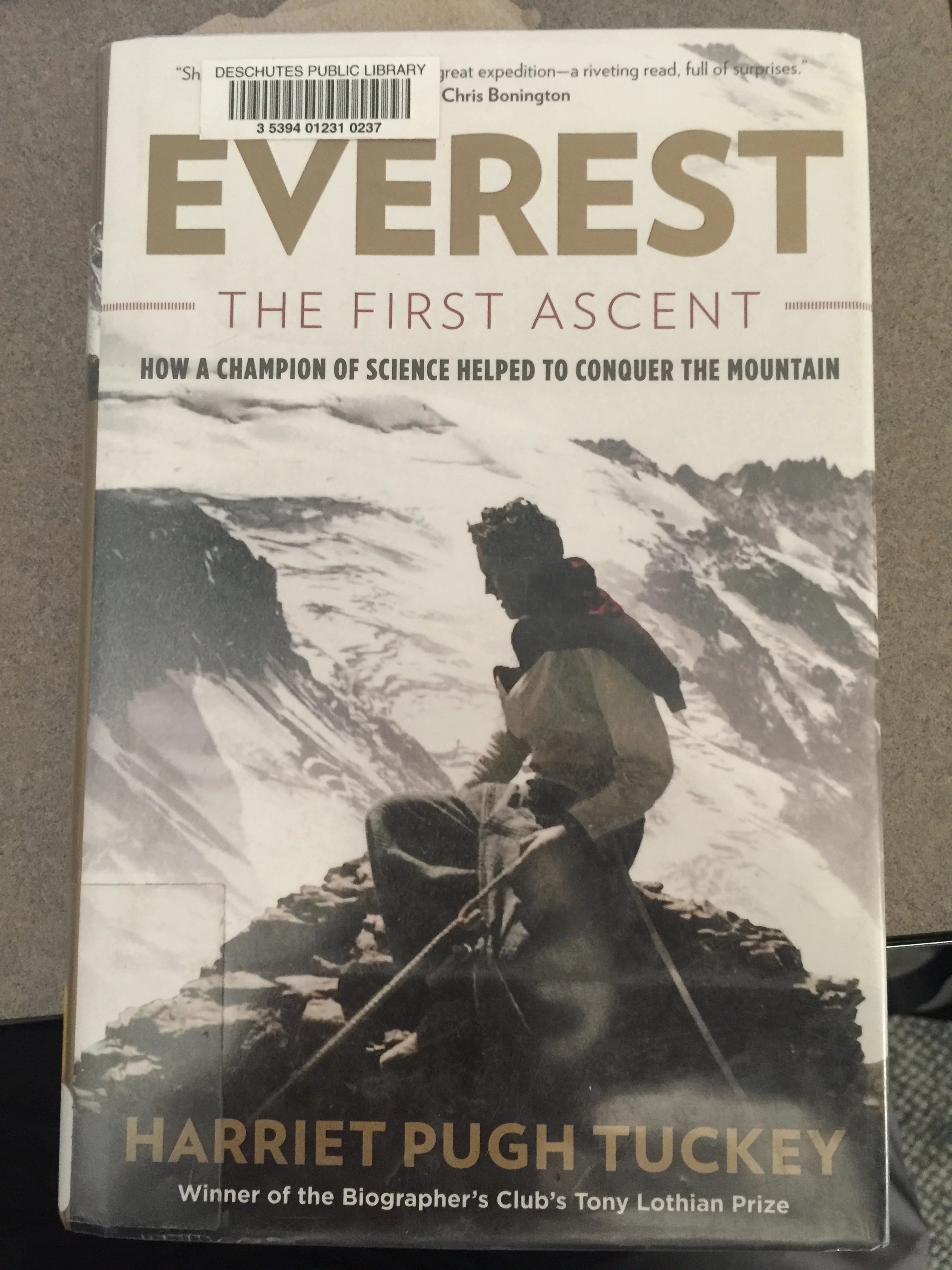
Today’s post is about risk. I’ve been reading a really good book at about the first successful attempt at climbing Everest - “Everest: The First Ascent: How A Champion of Science Helped to Conquer the Mountain.” There are many books about that first climb, but this one takes a different tack which I find interesting; it’s written by the daughter of the team’s chief scientist - a physiologist named Griffith Pugh. As would befit a book from this perspective, a lot of the book covers the attitudes of the climbers towards science, and towards having a scientist with them. Everest had been attempted many times previous to this climb, and they had all failed - of course - and failed in largely the same way; suffering from dehydration and altitude sickness, the climbers would retreat at or around 27,000 feet. All of these climbs - the British ones at least - were arranged by the Alpine Club, which was an amateur climbing and mountaineering organization. That group had the attitude we often find among amateurs: do your best, give it your all, and whatever happens, happens. But for the climb in 1953, the prevailing political winds had pushed against this attitude. It was commonly felt that the other nations, such as Italy at Switzerland, which had been getting more and more interested in the climb, would succeed in ’54 or ’55. They had no compunctions against using modern equipment and science, and so the British were pressured into accepting things such as the use of oxygen, and special climbing tents and equipment. And Griffith found himself right in the middle of this. One page of the book in particular captured this situation well, and I’ll just quote it largely verbatim:
“The Alpine Club, with its amateur sporting ideals, was less well disposed toward science. As…onetime club president Leslie Stephen told members in 1924: ‘True alpine travelers loved the mountains for their own sake and considered scientific intruders…to be a simple nuisance’. By the 1930s an influential contingent had become convinced that the huge size and mixed objectives [mountaineering and science] of the early Everest expeditions, with all the scientists and their equipment, were largely to blame for the repeated failures…In the mid 1930s [this] Alpine Club view gained the ascendancy, fiercely advocated by iconic Everest veterans…The Royal Geographic Society’s scientific aspirations were set aside; the juggernaut missions of the past were supplanted by small, flexible expeditions far more enjoyable for the climbers and more consistent with their sporting principles. After World War II, the ideas…that only climbers could understand the needs of other climbers, and that small casual expeditions were the only type worth going on - remained articles of faith…in perfect harmony with the public-school sporting ethos of ‘untutored brilliance’, the so-called ‘Corinthian Spirit’ by which gentlemen sportsmen achieved effortless success without really trying. Only the mundane professional - an altogether lower order of person - would stoop to engage in elaborate preparations and heavy training, or feel the need for scientific advice.” (emphasis added)
I have always been a sportsman and a competitor, a sort of “weekend warrior”. I enjoy competition and sports; I played a lot of sports when I was a kid, and as an adult, I’ve been a marathoner, a climber, a soccer player, and a distance cyclist. There’s lots of reasons that I do these things, some of which have nothing to do with sports per se; the feeling of motion, being in better shape, meeting new people, visiting new places. Putting all of those things aside for the moment, though, I find myself really interested in the competition side of it. By which I mean not necessarily competition against others, but rather competition against oneself, or against nature. In one of my Outdoor Leadership classes, we’ve talked about “risk equilibrium”. This is the notion, among sports psychologists, that we as humans seek to maintain a specific level of risk. If we encounter too much risk, we pull back. Intriguingly, though, if we encounter too *little* risk, we search for ways to add in more. For example, studies that attempt to isolate the effect of safety equipment often have the problem that people who wear safety gear - because they feel safe - do more dangerous things. I find this idea of “Corinthian Spirit”, and the idea of “risk equilibrium”, very interesting in more personal life and my approach to sport.
As with many human endeavors, sport and risk are things that happen on a continuum, and sometimes where we put ourselves on that continuum doesn’t make any sense. For example, on the one hand, we could have people try to climb mountains with nothing but their bare feet and a few scraps of clothing. That would be pretty ridiculous. We could also just helicopter people up to the top and drop them off there. Equally silly. Somewhere in between, we accept a certain amount of equipment and help as “acceptable”. We allow people to use canisters of oxygen, at least above a certain elevation. We use camp stoves to heat ice and make water. But we don’t use that same propane to power an engine to power us up to the top. We allow poles made of carbon fiber and jackets made out of complex synthetics, but we don’t allow someone to be carried up the mountain. I recently watched a video about a man with cerebral palsy who climbed Mt. Kilimajaro and they made a big deal out of the fact that one of his sherpas had to assist him up a couple of the more technical sections of one of the shear rock faces. It’s not even clear - even to mountaineers themselves - what exactly the “rules” are. It seems that it has something to do with lifting and moving yourself using only your own power - but clearly some assistive devices are allowed, such as really good shoes. Clearly we have an advantage over climbers from the 1950s - who themselves had an advantage over climbers of the 1920s. But, somehow, there is a human need to carefully avoid having an *unsporting* advantage.
And we still do this today - the rules about doping or drafting in cycling, for example. The best example may be golf, which has elaborate books full of detailed rules about the specific kinds of balls and clubs that are allowed. Golfers, for example, are not allowed to use GPS devices to tell how far they are from the pin - but they are allowed to employ caddies who walk the courses and memorize - yes, memorize - how far it is (using a GPS as their guide of course) from each major spot in every hole back to the flag.
One of the things that always amuses me about sport is the idea of trying to explain the internal logic of these rules to an alien. Imagine trying to explain to someone with no knowledge of human physiology or psychology why we’re allowed to ask a caddie how far it is to a pin but not a GPS. Or why you can have someone follow you on a motorcycle and hand you water in the Tour de France but you can’t ride too close to another cyclist.