Comment

Day 322 - Portland, OR

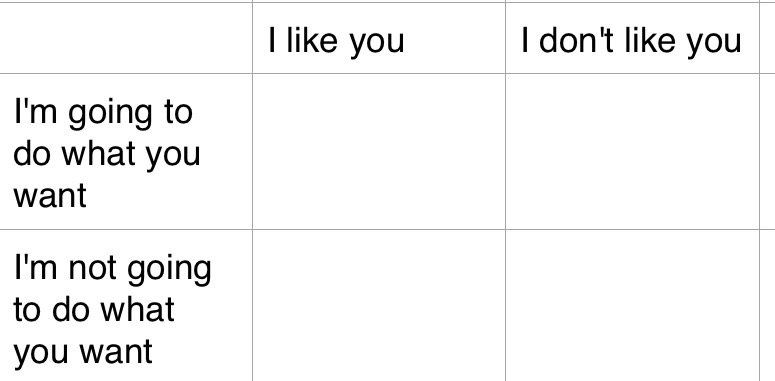
It took me a long time in life - 30 years or so, to be exact - to realize that I was a people pleaser.  Now, many people who know me might be surprised by that designation.  I rarely actually please people, so if I'm a people pleaser, I guess I'm not a very good one.  But that isn't exactly what the phrase means, I discovered - at least not to me.  Take a look at the graph below - this is what I feel like most people are thinking: 


image.jpg

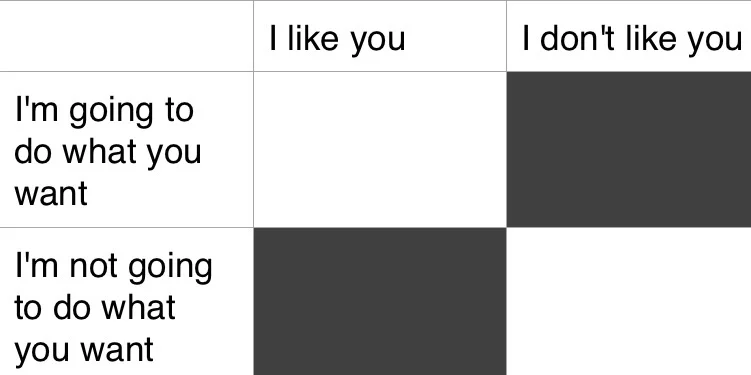
There's a universe of possibility here to move around in.  Now here's what mine looks like: 


image.jpg

See the difference?  It's not that I have a problem doing something other than what someone wants me to do.  It's that I tie that together with it being an aggressive act; a sign that I don't like, or am unhappy with, that person.  Which of course isn't true.  And it means I have trouble in certain situations.  Like when dealing with people - say, in the service industry - that I disagree with.  It's hard to stay positive, and stay friendly.  Fundamentally, the logic goes, since I'm not doing what you want, I must not like you. 

More importantly, I find it really hard to relate to someone I care about while still not doing what they want me to do.  Standing up for myself makes me feel disconnected from them.  Which is the opposite of how it should be; being able to be yourself and trust the other peron is a moment of intimacy, not estrangement.  But because of my screwed-up graph, I find it hard to see that.  Because I'm not doing what you want - the logic goes - I must not like you or be compatible with you.  Which, of course, is nonsense.  Nobody agrees with another person about everything, and if they did that would be creepy.

Theres a third problem here, too, a bit more subtle.   Notice the center of that graph. There's sort of a "pinch point" right in the middle.  Instead of freely moving around, the center is kind of stuck.  Which means that, when I'm in the middle - meaning I don't have a strong preference - I get confused.  I feel like I have to resolve things to one corner or the other.  Seemingly minor and unimportant things become an internal referendum on whether I like a person.  That false need for clarity ruins the freedom of play that can make a relationship so rich.

Of course, the goal is to not be like this anymore.  I've made progress, but there's more work to do.  I'm explaining this here to remind myself to keep working - and also in case it resonates with any of you out there! 

Comment

Comment

Day 321 - Portland, OR

image.jpg

In my time on this Earth, I have been to three of what are considered the greatest urban parks in America.  And all three - while great - are very different from each other and reflect, in my opinion, the differences in the cities they represent.  Without anthropomorphizing too much (I believe Freud said “sometimes a park is just a park”), here we go:  first, Central Park in New York City.  Now, admittedly it’s been about 8 years or so, but from what I recall, Central Park was magnificent - but kind of not exactly much of a park.  Meaning, it had a pretty heavy hand of man.  I remember amusements such as a carousel, vendors selling things, somebody renting horses, and big open expanses for people to run on.  It was heavily “improved”, in the sense that people had made it suitable for people-type activities.  

Next, we have Golden Gate Park in San Francisco.  GGP is kind of in-between.  The part near the east end is improved, definitely, with two museums, a carousel, and a few roads where people stroll and bike.  It even allows cars in parts of the park.  However, as you head west, it gets fairly wild and open, and there’s a lot of trails and not much in the way of signs of man.  And even the parts that are built up are fairly sedate and still covered in vegetation.

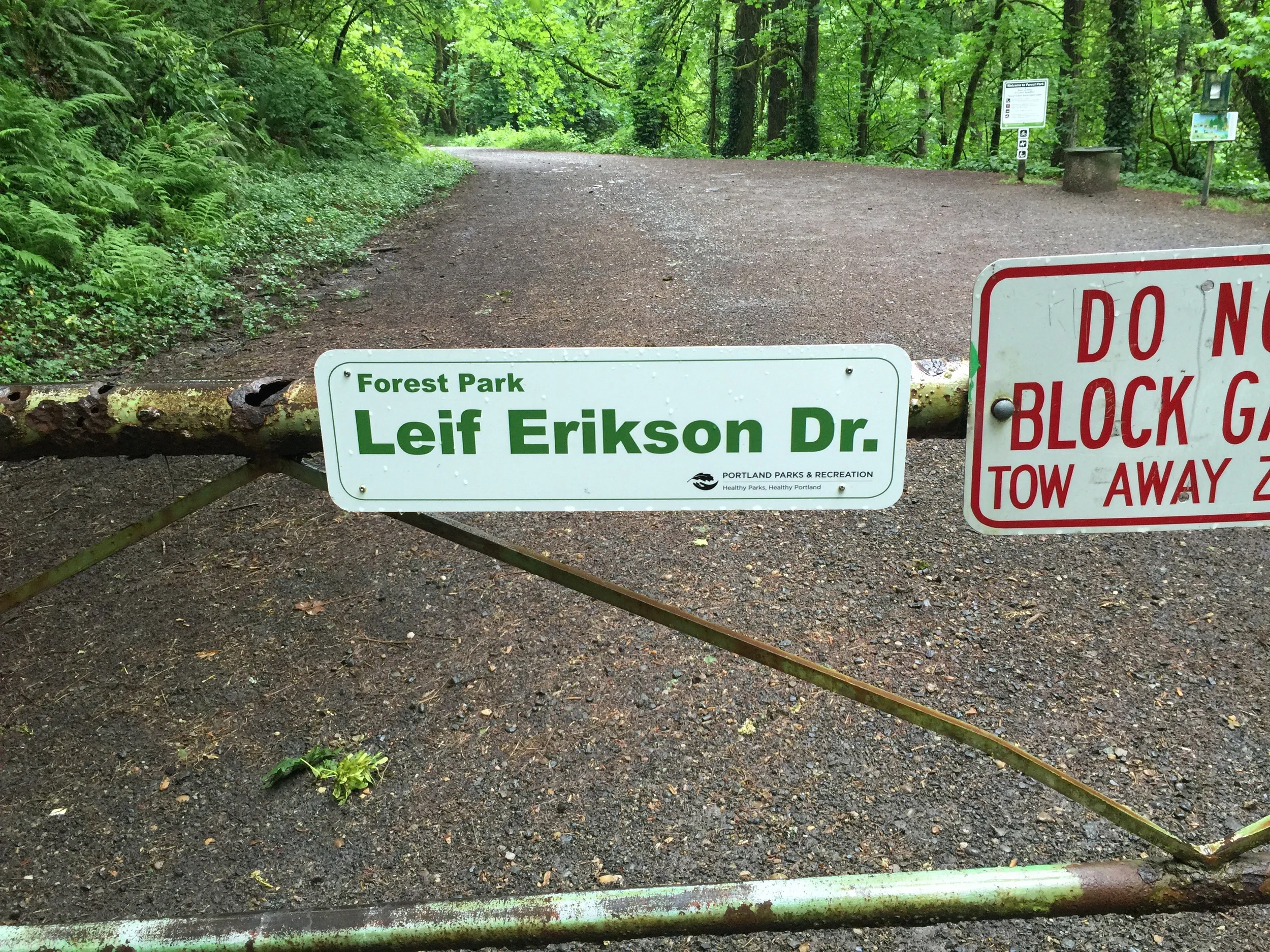
Then, you have Forest Park in Portland, where I hiked about 12 miles today.  Forest Park is a good name for it because it’s basically just a forest that happens to be called a park.  It seems as though a few folks just built a dirt road or two through a big stretch of Oregon forest and said “hey you crazy kids, go for it.”  It’s exceptionally natural and has been treated with a very light touch.  There are no attractions, or museums, or people selling things.  It’s just a park.  Apparently, it was supposed to originally be a housing development, but the road got washed out and they just made it a park, thus creating the famous Portland saying “if at first you don’t succeed, just turn it into a park”.

So, yes: New York is the home of man, San Francisco is the home of an uneasy truce, and Portland is the home of the forest.  Broadly speaking.

Comment

1 Comment

Day 318 - Mt. St. Helens, WA

image.jpg

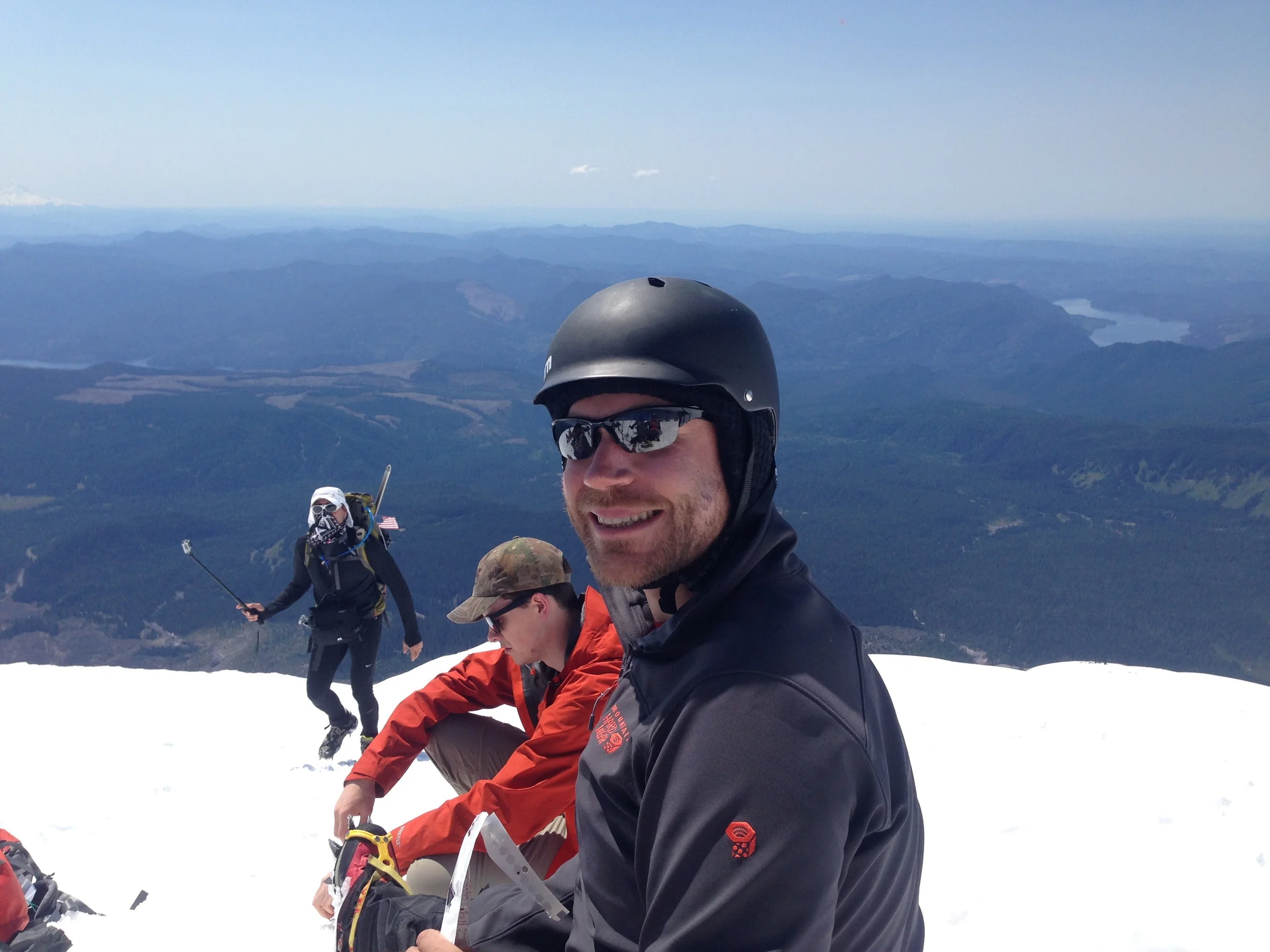
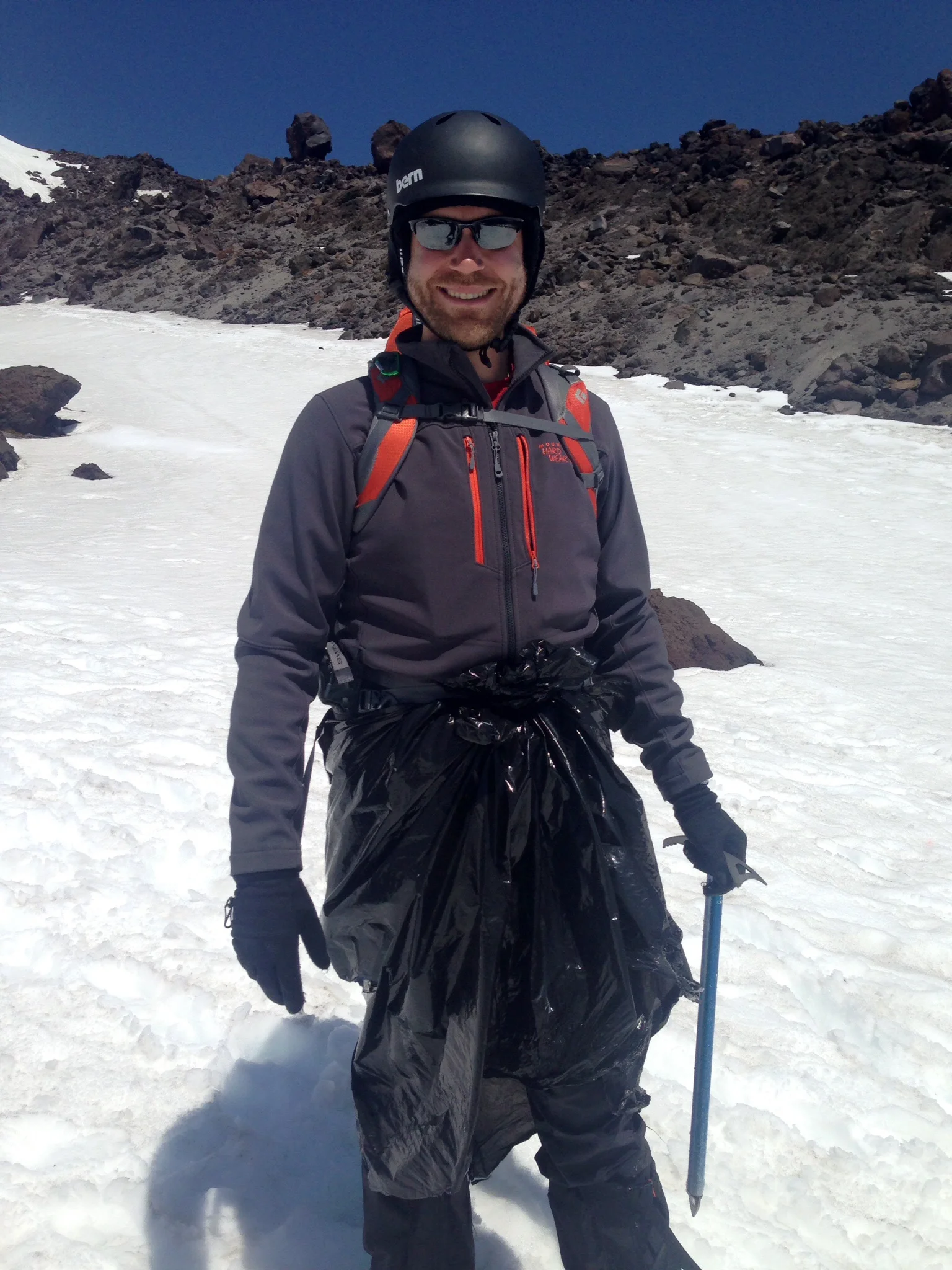
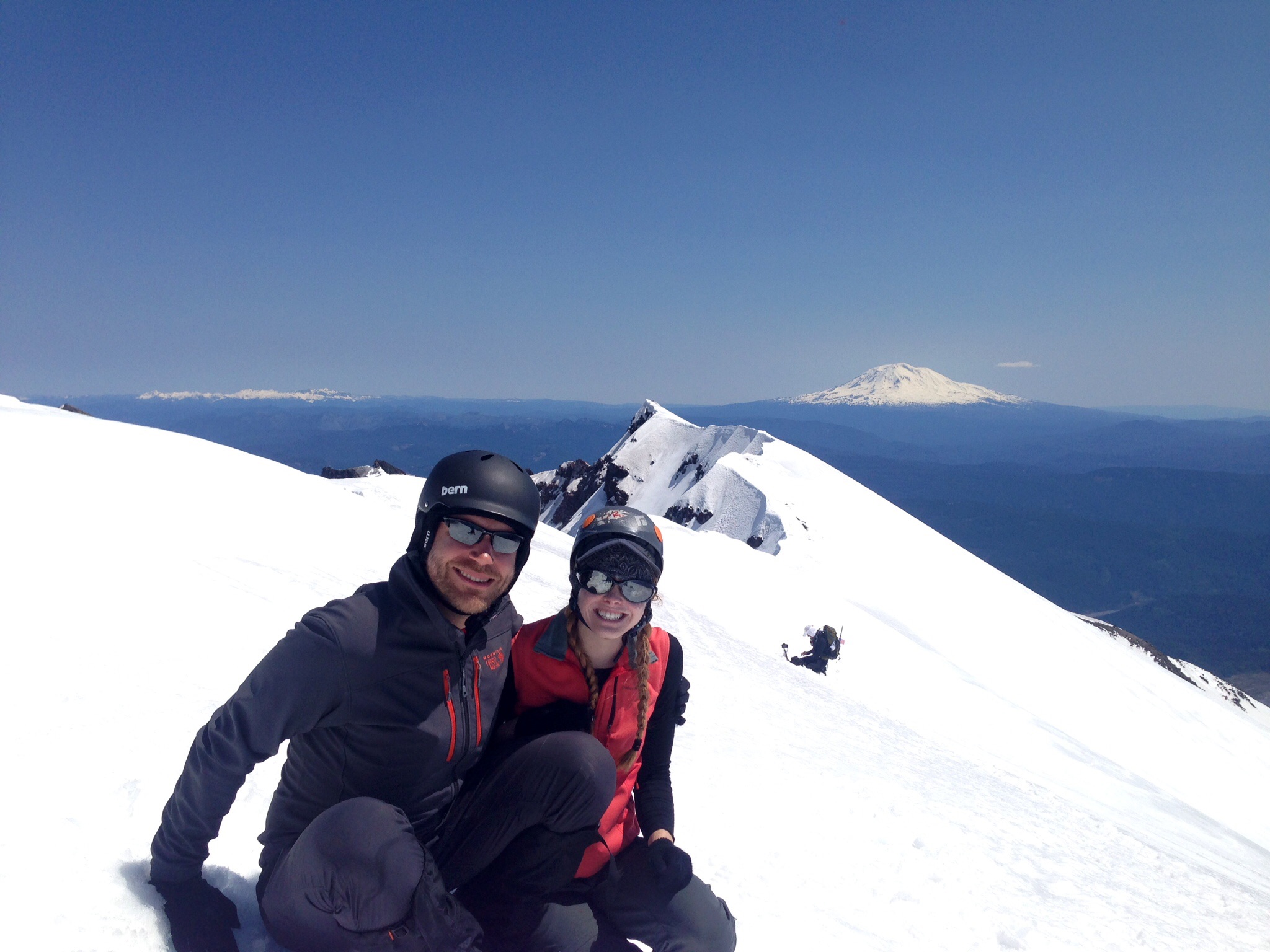
Yesterday I climbed Mt. St. Helens.  It was my first climb with the Mazamas Mountaineering group.  For those of you who read about my last glaciated peak summit of Mt. Thielsen, this couldn't have been a more different experience.  It was pleasant, one might even dare to say "easy".  Except, of course, mountains always exact their revenge: I ended up rolling my right ankle pretty good.  But it won't keep me down long.  On the plus side, I ended up learning my new favorite word: glissade, v.: to have the most fun ever in the history of ever.  Glissade is a mountaineering word for something every 5-year-old knows: if you put plastic on your butt and sit on a snow hill, you will slide down it.  And it will be fun.  Our mountaineering guide, Greg, showed us how to glissade about half of the 4500 vertical feet we climbed up safely.  It unlocked my inner child and was basically the best time I ever had.  Sliding down a clean fresh snowbank at 8300 feet is...well, amazing!  I can't wait to do it again.

image.jpg
image.jpg

1 Comment

Comment

Day 316 - Portland, OR

One of the things I really love about sports is that it’s true human theater.  At its best, it exposes our humanity, our strange psychology.  It’s like a play, except that nobody - not even the participants - knows the ending.

A few things happened in sports over the last few weeks that i find interesting from a psychology perspective.  The first is the issue of the Patriots and Deflategate.  I realize that many of you find sports terribly dull, but bear with me here: the game of football, like many modern games, has a lot of rules about equipment.  One of those rules is that the balls themselves have to be inflated to a specific pressure.  There are various sports-y reasons for this, but suffice it to say that an under-inflated ball can have certain advantages.  Somewhat bizarrely, the NFL allows the teams to supply their own balls, although they are checked by the officials.  Well, it appears that, during the run-up to last year’s Super Bowl, the winning Patriots most likely systematically under-inflated their footballs, and that their star quarterback most likely knew it was happening.  Now, it is clear that this is not the reason they won the game; the Super Bowl was a blowout, and the Patriots certainly would’ve won anyway.  But - in sports - as in life - that isn’t the point, is it?  A tweet from another player on another team sums it up:

“1. I'm not surprised 2. They still won and a deflated football doesn't help that much 3. It's all about integrity”

Integrity…an interesting concept.  Nobody thinks that what the Patriots did is necessarily the cause of their victory.  And it’s not clear that anyone is seriously suggesting that they should return the trophy.  But what is clear is this: people don’t like the Patriots.  There is an almost universal sense that most people wish they hadn’t won.  Yes, they are winners, but really, they are still losers.

One more example from a different sport drives this point home.  Last week was the “fight of the century” in boxing.  Mayweather vs. Pacquaio.  It was incredibly hyped and both fighters made over $100 million.  From a sports standpoint, it was a boring fight, both in practice and in theory.  The better fighter - Mayweather - won handily, using a very effective strategy.  He boxed well and won.  Nothing to see here.  But what interests me is this: everybody hates the guy.  One commentator said he “lacked likability”.  Of course, there’s the fact that he’s a confirmed wife beater and a jerk.  But that isn’t all of it: he also just *isn’t very good at being entertaining*.  People don’t like watching him box.  His style is boring and defensive.  It’s effective, but it isn’t fun.  And people very much want him to lose.  Conversely, Pacquaio - who is apparently also a little loose with the women and possibly a bit of a jerk - is a national hero and loved by millions.  Why?  Well, perhaps it’s at least partly because he obviously wants to entertain us.  He cares that we’re enjoying watching him box.

What is the overall lesson here?  I’m not sure, but I think it’s something like this: “winning”, in life, is at best a secondary goal.  It’s an objective to aim for, but it’s really about the journey, not the destination.  Bagging that dream job, or dream girl, or dream apartment, isn’t as important as how you conduct yourself on the way there, and what you do with it when you arrive.  This week another thing happened: Stephen Colbert donated $800k to the teachers of South Carolina, in dramatic fashion: he approved ever single grant request from them to a specific Kickstarter-esque website for teachers.  Everyone loves the guy (including me), and with good reason.

Comment

Comment

Day 308 - San Francisco, CA

I always wondered what it would feel like to leave San Francisco.  I’ve thought about it many times over the years.  I almost did it, a few times.  I had endless conversations with my parents, walking up and down Haight St, screaming into the phone about how unhappy I was.  Stumbling around 7th and Harrison, after I left my keys at a speed dating event and they were gone when I went back.  I pictured slinking back to Austin as a failure, tail between my legs.  On good days I imagined finding the woman of my dreams, moving in together, then eventually - when we decided to have a family - heading to someplace like Austin, or Oakland, or Madison, WI.  One time I almost took a job in Iceland, just because the women seemed hot and interesting and I was antsy.  In the end, though, what happened was none of those things.  After way too many years of living various unhappy lies, I finally moved out of San Francisco about a year and a half ago.  Oh, not physically - I still lived here, at 1970 Hayes.  But mentally I left.  After the ashes of Kimberly leaving me died down, I went on yet another dating spree.  I considered moving into a swanky $5000 apartment downtown.  I bought nice clothes from Express, and Jack’s, and Lululemon.  I tried to focus on work.  I dated a fashion model, two redheads, and a woman who made me enter and leave her apartment through the window so her roommates didn’t know I existed.  And one day, I had enough.  I can’t tell you what exact day it was, but it must have been about Christmas, of 2013.  That year I drove from SF to Austin for the holidays.  I don’t even remember why.  But I remember I was in the car alone on Christmas Day, somewhere in the middle of nowhere.  I stopped at the Grand Canyon, and I only stayed about an hour or two because it was -2 degrees and I was in short sleeves.  I don’t honestly even remember much of what I did on New Year’s Day.  I imagine I did something.  Maybe I hung out with Mark?  Can’t recall.  Somewhere in there, though, I made a fateful decision - to take a month long yoga retreat.  I had been doing some yoga for a while; a holdover of Kimberly’s time with me, when I discovered meditation but realized it was too slow and I needed some action.  I was a babe in the woods, although I didn’t know it at the time.  It honestly seems like only yesterday, but the calendar tells me it was February of last year, almost a year and a half ago.  I met 30 amazing people.  I’d love to say it was an instant transformation, but of course it wasn’t.  I stumbled through it.  I ended up dating someone from the retreat, who was easily as messed up as I was.  I told her that she was a threat to my happiness.  Then she drove me to Tahoe and left me there and told me to take the train back.  Nobody I knew was stable, least of all me.

But something changed during that yoga retreat.  Or, maybe it had started changing before that, and this was the first bubble that crested the surface.  I sat, while the amazing Darren Main led us in Pranyama, and cried like a baby.  I lifted up into full wheel.  I joined a men’s yoga club.  I ate vegetarian food.  Mostly, though, I stopped thinking about computers as much.  In the following year, I did some contracting here and there, but mostly, I learned about myself.  I got trained as a personal trainer.  I played Hearthstone.  I went to my buddy’s farm and moved marijuana plants (they’re surprisingly big).  I stopped dating, then I started again, then I stopped.  Finally, I had enough.  I made plans to leave; to ride my bike in the summer,.  So I did; 2600 miles.  If the yoga retreat was the beginning of the end, the bike ride was the middle.  I learned a ton about myself, documented elsewhere here in this blog.  I rode through tiny Bend, Oregon, and I liked it a lot.  I met an amazing woman and we joined hands for the Oregon Country Fair.  She showed me the door back to a happy place (thanks, Emili with an “i”) and then had the good sense to get married (and not to me!).  I had the time of my life, quite probably - at least up until now.  I hardly touched a computer, except to update my blog.  A few months after I got back, I knew I needed to leave, and Bend came to the top of the list.  I looked for an excuse to leave, and found one at the Outdoor Leadership program at Central Oregon Community College.  So, not knowing a soul in Bend, I packed up my car, rented my room to a stranger, and left.  At the time, I knew it was temporary.  Although I had imagined leaving San Francisco as a singular moment, in truth it’s been a journey.  And even though I’m leaving again this weekend, this time for Portland, I have no way of knowing if this is the last time I’ll sleep in this town.  In fact, it’s quite likely that it’s not.  But one way or another, the “San Francisco” phase of my life is over.  It started to end about a year and a half ago, and it comes ever closer to ending this weekend.

There are so many great people here.  There are also very many toxic people here, especially if you let them get under your skin.  But I’ll choose to remember the good ones; Leah Bradley, Micah Potts, my brother Jason, Abby Sanford, Katie, Silke, David (both of them).  All of them will be part of my life going forward; and not just spiritually; I’’ll be back to visit, and you should all come to visit me.

Eating dinner with a friend of mine who lived in Portland for 6 years, he described it - affectionately - as a place where ambitions go to die.  And it’s true.  The very thing I complained about in San Francisco is one of the things I needed the most; the challenge.  It is so hard here that it hones you; it breaks you down until you really decide what it is you want in life.  It’s a deceptively hard place, where people have trouble getting close, and the stress is palpable, hanging in the air like the fog.  For all that, though, it is a place of many good memories nestled in among the truly crappy ones.  I know I’ll be back.  But it will be different this time.


Comment

Comment

Day 303 - San Francisco, CA

Recently, a company I used to work for laid off some folks and appears to be in some difficulty.  At least that’s what I hear; the exact terms are secret, and I don’t work there anymore, so I’m not privy to all the details.  There’s a lot I could say about this happening; that place represents a big part of my life and I’m sad to see it go.  And, overall, That company and the two guys that founded it were extremely good to me, so I don’t want you to interpret any of what I’m about to say as disparaging them in any way.  They were, and are, awesome.

But one (relatively minor) aspect of this interests me.  If they go under, my 6,000 or so shares of their stock became worth essentially nothing.  This represents approximately the seventh or eighth time in my career that a company has given me stock in themselves as part of their compensation package.  Only once, of those seven or eight times, has that resulted in any money for me.  That one time was Google,  and the shares I got there turned into about $25,000 after a year and a half of work - a very nice windfall, but not exactly a game changer.  The other six or seven times they were worth nothing.

Offering shares as part of a compensation package is a standard Silicon Valley modus operandi.  It’s become so well known it’s almost a societal trope; the underpaid wunderkind who works his tail off for Twitter before anyone even knows what a Tweet is, and comes away a millionaire.  

But the truth is that, much like any form of gambling, most people lose.  And make no mistake about it; accepting stock as part of a compensation package is gambling.  Consider, for a moment, video poker.  Clearly there is an element of skill (the “poker” part).  If you play exceptionally poorly, you are sure to lose your money.  But even if you play optimally, you will still eventually lose.  The fact that some skill is involved does not transform it into a game of skill.  Similarly, when you accept stock in a company you work for, the insinuation is that, because you are a part of that company, you can affect whether your stock is worth anything or not.  This is - within a measurement error - simply not the case, as anyone who has been through the process can attest.  Only perhaps the first couple of founders can have any significant affect on the eventual fate of a company, and even then they are often quickly swamped by the impact of investors.  I was employee number 7 at this company, and got there well before they grew; even still, it would be pure hubris on my part to claim that I had any real role in its success or failure.  The fact is that you have way more control over a hand of video poker than you do over your stock.

In addition, the deck is stacked against you.  Accepting compensation in the form of stock is like making an extremely risky investment about which you know little.  You are underinformed, over-leveraged, and essentially in over your head from day 1.  

I have no problem with the idea of companies offering stock to new employees, per se.  Just like I don’t have any problem with them offering free lunch or yoga classes.  But the truth is this: the free lunch and the yoga class is almost certainly worth more than that stock, and it is disingenuous in the extreme - to the point of flat out untruth - to try to claim otherwise.  Advertising stock as a significant part of a compensation package is akin to telling a lottery player that they are sure to win.  It is morally and ethically bankrupt.  Even a successful company - like this one was - is very likely to eventually either go out of business or achieve a steady state, and in either case your stock is essentially worth zero.  And of course most startups simply quickly fail.  The odds of a successful conversion event that awards you significant monetary value are so incredibly poor as to be not worth mentioning.  More importantly, your role in that success is a rounding error at best.

To be sure, there is a growing awareness of this.  In my early dotcom days, I worked for a company which had the guts to offer a stock purchase plan to its employees wherein they could trade their salary - up to 100% of it - for stock.  I knew a guy who wrote a check to the company every month, to pay his salary taxes, and took 100% of his compensation in stock which - you guess it - ended up worth precisely zero.  And that was considered a successful company, which is still in business, but simply never went public.

I firmly believe there will be a legislative backlash against these tactics in the future.  Until that happens, though, if you know any young engineers, suggest that they politely ask for cash.  If they want to gamble, they’ll get better odds in Vegas.

Comment

Comment

Day 295 - Austin, TX

image.jpg

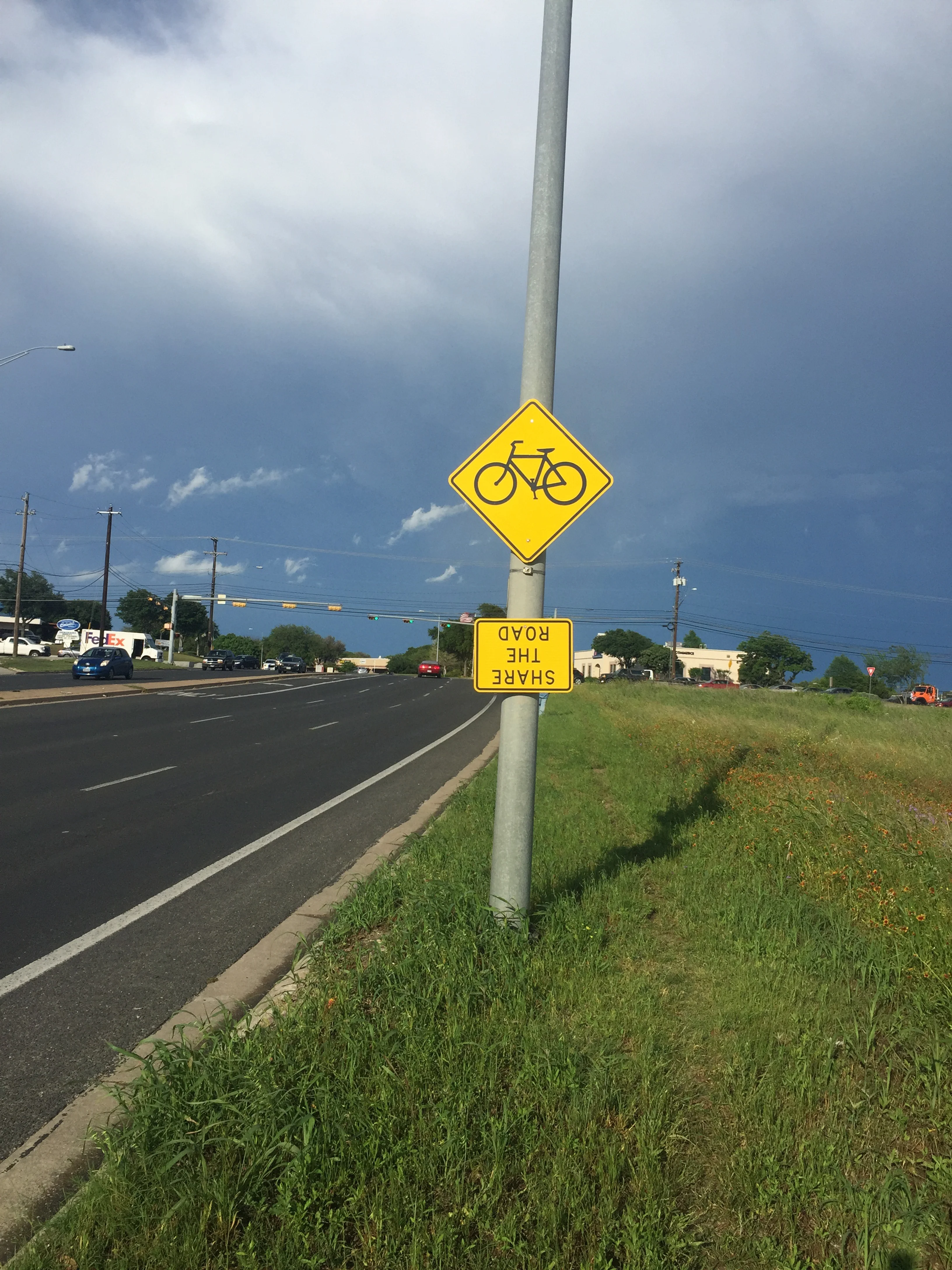
I love Austin.  It’s hot - in all the ways.  The 8 or 9 years I lived here were some of the best years of my life.  So please, Austinities, rest assured that I think it’s an awesome town.  Which is all the more reason for a little “tough love”.  Over the years, especially since I left this place, I’ve developed quite an affection for walking, cycling, even scooting - alternate modes of transportation.  And since I’ve been visiting my friend Mark without a car, he’s been kind enough to let me borrow his bicycle, which I had to walk down to the local bike shop to get fixed.  The point is, I’ve been doing more walking and cycling than I used to do when I lived here.  And I can honestly say that Austin is one of the worst cities I’ve been in for being a pedestrian.  Another thing that’s happened in the years since I left is that I’ve been in some great walking cities - San Francisco, of course, but also Bend and Portland and Paris and even London.  Now, some would say that the problem with Austin is just that it’s a southern city, and large, without a tradition of walking and cycling.  And there’s some truth to that.  But the thing is that Jacksonville - *Jacksonville*, of all places - has done a much, much better job in the last 5-10 years of putting in sidewalks and bike lanes.  I would actually say that biking around Jacksonville is pretty pleasant.  So really there’s no excuse.  I was in the Bicycle Sport Shop here in town and mentioned something to the woman there about what a hard time I was having walking around town.  And she didn’t even try to defend it.  She said something about 2 ton pickups with drivers that have something to prove.  There are parts of Lamar street that are just plain dangerous - with no sidewalks, either.  Even in the parts that have “bike lanes”, they are way too narrow, and the drivers just show no respect at all.  One guy came within a foot of my ear.  They just don’t care.  There’s one part on Braker where someone has gone in and installed “Bike Route 10” signs; but it’s a joke.  There’s no bike route.  There’s nowhere to bike except right in the middle of the lane, and good luck with that, as F250s breathe down your neck.

It’s a shame, really.  There’s definitely a running and cycling subculture in Austin.  And with the state of things in this country; obesity, diabetes, etc., it just seems like encouraging walking and cycling would be a great thing to do.  And if Jacksonville can do it, you can do it.  So - do it!

Comment

Comment

Day 294 - Austin, TX

Today, a new trailer for Star Wars: Episode VII: The Force Awakens was released.  It’s difficult for me to write about what Star Wars means to me.  In some ways, I’m not your “typical Star Wars fan”.  For one thing, I’m too young, I guess.  I was born the year Star Wars came out.  I remember vaguely my family telling me that they took me to Episode VI when it came out, but I would have been 6 years old, and honestly I don’t remember it at all.  My first explicit memory of Star Wars was when I was a junior in high school and I went to a summer camp at Florida State, and one evening the counselors at the dorm arranged for a marathon viewing of all 3 episodes back to back.  I remember that I was already a fan of the movies at the time, so I must have seen them somewhere, but I honestly don’t remember where.  And, while I was a fan, I wasn’t a Fan, you know what I mean?  I just thought they were cool, like very red-blooded kid of that age.  Darth Vader was cool.  Light sabers were cool.  The Force was cool.  Girls didn’t like it much, but that was OK; girls didn’t like anything cool.

So, in many ways, my first real “Star Wars fan moment” had to wait until the prequel trilogy came out; Episodes I, II and III, that is.  By that time, I was an adult, and I could participate along with everyone else.  We saw the trailers, debated the minutiae of them frame-by-frame, bought the early release Burger King cups, then stood in line to watch the actual movie, waiting several hours.  It felt like the whole world shut down that day.  Watching the first movie, I remember actual really enjoying myself.  Jar Jar was super annoying, yes, but other than that, it seemed like fun.  It was actually a bit surprising to me when everyone hated it so much.  I can recall arguing with my friends a bit; because I thought it was “only mediocre”, I found myself having to defend it against my angry friends.  In those days, the internet was absolutely a thing, but it didn’t yet quite have the style-defining importance that it would come to have later.  I remember Ain’t It Cool News was really upset at the movie.  Talking with my friend Mark today, I realized that one reason that perhaps I didn’t think the prequels were all that bad was because I didn’t have that intimate relationship with the first three that some people had.  The low lows required higher highs, so to speak.

Now, I’m further along in life, getting closer to what some might call middle age.  And here we are with the third go-around.  But there’s a few changes this time.  First of all, I now have something to be nostalgic about: namely, the prequels.  They happened so long ago now that they define a time in my life.  It so happens that, by coincidence, I’m in Austin this week, so it’s doubly poignant in a way.  As some of you know, right around the time of the prequels - a bit after them, if I remember right - I spent 3 years working on a Star Wars video game.  So to me, Star Wars, and the prequels, are all tied up with that time in my life - a time when I was married, when I had a solid group of acquaintances.  When I had people to shoot the shit with - and Episodes I-II-III were very popular shit to shoot, to coin a phrase.  It was a simpler time, both for society in general, and for me in particular.  And I *am* nostalgic for it; maybe not for the movies, per se, but what they represented for me.  The Star Wars movies feel like signposts in my life - the first one came out the year I was born, and the second set came out in a very defining phase of my life.  There’s another change this time, too: this time around, our most recent experience is that Star Wars sucked.  So there’s a dialectic to confront.  I feel strongly that part of the reason people disliked Episode I so much was because they liked Episode IV so much.  So it stands to reason that part of the reason people will like Episode VII so much is because they disliked Episode III.  And lo and behold, that seems to be happening.  The three series of movies form their own arc of three acts - the first good, the second bad, the third a redemption.  And this time, I get to participate as an adult.  In some ways, these sets of movies represent my life; a great childhood, a rocky transition, and now a bit of a redemption as an adult; a rebirth, if you will.

So, yes - the trailer is good.  And I’m looking forward to setting up all six movies on iTunes; even if I have to watch them by myself.  And I can’t wait for the new - new - Star Wars.

Comment

2 Comments

Day 277 - Bend, OR

image.jpg

Today’s post is about email, but really it’s about persistence.  A week and a half ago, I had 221,000 unread emails.  Yes, that’s right - 221,000.  I’m not adding an extra zero.  Fifteen or so years ago, back before Yahoo was even a glimmer in any founder’s eye, I created an “e-mail” address on the “World Wide Web”.  I chose a service almost completely at random because I liked the name, Rocket Mail.  At the time, I was fascinated by the Princess Bride, and specifically the character of Fezzik  (who am I kidding - I still am).  Et voila, fezzik@rocketmail.com was born.  I didn’t consider it terribly important.  I highly doubted I would use it for anything important.  Ever since then, I’ve thrown it around willy-nilly.  I never hesitated to give it to anyone.  It was the village bicycle - everyone had a ride.  But it also became an incredibly important gateway to friends and even family.  Some are amazed that I could have accumulated 221k unread emails.  I’m honestly surprised it isn’t higher.  

A few times over the last few years, I sat down to try and clean it out.  It had gotten so hard to find things, and so unwieldily, that Yahoo’s servers (Yahoo bought Rocket Mail about a year after they started) choked on it.  I’m probably one of the only people in the world that pays Yahoo actually hard cash to have a Yahoo email address, because the free email simply couldn’t handle it.  The first few times I sat down to fix this problem, I tried to find a technological solution.  I looked at different 3rd party tools, from scrapers to POP3 clients.  I came delicately close to inadvertently deleting the whole account one time.  Nothing I found could do the job.  Every time I went to fix it, something more important came up.

There’s an interesting life lesson in here somewhere, and that’s one of the reasons I chose to write about this.  It is not the most critical thing in my life that this email address work well and get cleaned up.  And, at any given time, there is zero chance that it ever will be the most important thing in my life.  But it is the kind of task that can only be handled if it is treated as if it was the most important thing in one’s life - with concerted effort and an intense focus.  That means that, unless I ever chose to intentionally sit down and address it - despite it not being the most important thing at that moment - it would never get done.  It wasn’t going to get better on its own.  And a future where I had, quite literally, a million unread emails was both entirely possible to contemplate and also kind of creepy.  There is a fundamental difference in life between tasks which are important and those that are urgent.  It’s not easy to balance the two.

Today, I have approximately 28,000 unread emails.  That’s still a lot, and I will be continuing to put energy behind addressing it.  But it’s only about 10-15% of the problem, and I can now see the light at the end of the tunnel.  My dream is to get back to the mythical zero inbox.  I may not quite get there, and that’s OK, but if I can get under 1,000 I think I’ll declare a success.  (It’s mostly about being able to find old things, and at that size, I can manually search if I need to).

What’s important in your life that isn’t urgent and likely never will be?  Do you want to take care of it?  If not, be gracious in defeat and move on.  If you do, though, then when?  As they say, no time like the present!

2 Comments

Comment

Day 273 - Portland, OR

Today, I find myself thinking about the pilot who appears - if investigators have it right - to have intentionally crashed a commercial airliner into the alps, killing 150 people, including himself.  There’s obviously a lot of questions to be answered here, not the least of which is “if you’re going to commit suicide, why take 149 other people with you?”.  An excellent question.  But what the whole sad incident makes me personally think about is the increasing isolation of people in our modern society.  I’ve written about this before, for example when that guy snapped and killed a bunch of people last year, leaving behind notes about how women had mistreated him.  It’s not, of course, surprising that people should get depressed.  Since the dawn of time, there’s been a dark side to humankind that gets anxious and sad and feels worthless.  And being alone and isolated are also not a completely modern phenomenon.  Odysseus was forced to travel the world alone with only his dark thoughts.  Captain Ahab traveled the seas bent on revenge.  But what is new is the depths of the Death of a Salesman problem.  Stripped of our connections to other people, it becomes so easy to get out of balance.  When I was in Early Childhood Education training, I remember one of my teachers referring to the parent of a teenager as their “external frontal lobe”.  I was struck by that thought.  As humans, we emerge from the womb less than fully formed.  Specifically, the brain is not complete (because otherwise we wouldn’t fit through the hips).  So parents are, in many ways, the external frontal lobe for their children.  But what I think is interesting about this is that I’m not sure it’s limited to children.  We, as humans, are inherently social creatures.  The people around us - our community - are, in many ways, a vital piece of our control system, of our decision making process - our “frontal lobe”.  When we don’t have that, our internal control systems have no check and balance.

One of the interesting things about the co-pilot case, to me, is that apparently nobody saw this coming.  Despite the fact that the man appeared to have had a family that cared about him (and perhaps he even lived with sometimes), a girlfriend, coworkers, etc - and despite the fact that he was apparently suffering from at least two separate ailments, one that was affecting his vision and another his mental state - nobody was able to put two and two together.  We are not talking here about some Ted Kaczynski loner off in the woods; this guy had a job, an apartment, neighbors, people who remembered him.  And yet, somehow, he apparently felt he had nobody to turn to.  I wish this was a novel phenomenon, an isolated incident, but this is something we all understand is happening to us as a species; despite all the new ways to communicate, we seem to understand less and less about the people around us with each passing day.  I have, personally, experienced what it’s like to feel incredibly down, or frustrated, and not feel like really have anyone to turn to.  I’ve been incredibly alone, even in the middle of a big city.  

This is not to suggest that I, in any way, condone flying a plane into the Alps.  There is something cowardly about suicide, but there is something truly reprehensible about taking 149 other people with you.  What I’m suggesting, though, is that unless we figure out a way to turn back towards caring more about the people around us, this may not be the last time.

Comment

Comment

Day 267 - Rogue River, OR

image.jpg

This post is ostensibly about hiking, but its really about risk.  First, I will give you the benefit of my 37 years of experience.  Which is this: Most of the time, you shouldn’t quit.  Except sometimes, when you should.  Got that?  OK, good.   If you’ve really internalized that, your prize is that you don’t have to read the rest of this post.

A little bit of background: I am not, generally, a quitter.    In fact, off the top of my head, I can really only think of two times when I’ve quit something in my entire life, and they both happened within the last year.  And one of them happened yesterday.  Now, there are certainly things that I failed to finish; my preschool teacher training, for example.  But that wasn’t really a “quitting moment”; other priorities just came along and I shifted my focus.  What I mean by quitting is that one moment in time, where you look at something, and for whatever reason - or for multiple reasons - you say “No.  No more, today at least.”    (That “today at least” part is important and I’ll talk more about that later).  The first time I quit, it was about 4 months ago, and I wrote about it here in this blog; you can go back and find it.  I had signed up for a 10 day silent meditation retreat, and after the first day, I walked away.  The second time, like I said, just happened yesterday.

I’ve been really interested lately in mountaineering, or alpinism - climbing things.  I had my own climb experience, which I also wrote about here, and I met some cool mountaineering folks, and I’m hooked.  It combines something I love - moving forward under my own power - with this really cool exploration of risk and adventure.  So I’ve been voraciously devouring every documentary and book that I can get my hands on - luckily, this being a hotbed for that sort of thing, the local library has a ton of materials.  There’s a lot of fascinating stuff in these stories.  Although on the surface it’s all about athleticism, training and equipment, when you distill it down, it really ends up being about one - or possibly two - things: risk, and self-awareness.  Having a good sense of what’s happening around you, and inside your own head, and knowing when to take that chance, and when not.  On one level, nobody would ever climb a mountain if they didn’t have a healthy ability to push through risk and fear.  On the other hand, these mountains are littered with the corpses of people who took it one step too far.  There’s a book I just started reading by Ed Viesturs, a famous Seattle mountaineer, and I’ll quote from the foreword - written by a friend of his - here:

“One of the stories that Ed told me early on was about how he turned back only 300 feet short of the summit of Everest in 1987 on his first Himalayan expedition.  He knew he could make it to the top, but he wasn’t sure he could get down alive.  That turnaround is an incredible statement…If I’d been in the same situation, I’m afraid I’d have told myself, ‘I’m this close, I’m going for it.’”

In 1996, a well-known tragedy occurred on Mount Everest.  On one single day, May 11, 1996, 8 people would die while attempting a climb of Everest.  Almost all of those died on the way back down from the top.  The story has been told and retold a dozen times, most famously in Jon Krakauer’s book Into Thin Air.  Although no tragedy like this has a single cause, the essence of the story is this: the hard part of climbing Everest - of climbing any mountain - is actually getting back down.  In the case of Everest in particular, mountaineers leave for the summit in the middle of the night, to ensure that after summiting, there is enough daylight to make the return trek.  Arriving at the summit too late increases the risk many fold, because spending a night out in the weather up at that elevation - called the “Death Zone” - is a terrible idea.  The right way to do the climb is to leave early, make good time, summit early, return safely.  Done, and done.  On May 10, some people did that, and lived.  Others did not, and died.  Now, this rule - to summit early - is not a secret.  It’s a well known fact that most mountaineers - certainly anyone anywhere near Everest on that day - would know.  Some of the climbers who died were inexperienced, but some had a great deal of experience, including previous Everest summits.  Why, then, did they go all the way to the top?

I’d read several accounts of this tragedy, but Krakauer’s book had an interesting anecdote in one of the Epilogues I hadn’t yet heard.  After the events of May 11, there were still a number of climbers and expeditions teams left on the mountain.  They had all heard an experienced the tragedy from close range, including hearing all the radio transmissions back and forth, and witnessing the rescue efforts.  Some of the climbers lost their stomach for the enterprise and left - but some pressed on, and others summited the mountain through the month of May.  One climber, in particular, Bruce Herrod, was doing a solo climb of Everest.  According to Krakauer, he was on the South Col when the tragedy happened - a few thousand feet from the summit.  He heard the whole thing.  Yet, not more than two weeks later, he attempted a climb to the summit.  He left late, he had trouble getting up to the summit, he finally made it at around 5 pm - way too late - and then died on the descent.  One particular chilling line from Krakauer recounts that Herrod had to literally step over the frozen bodies of at least 2 of the climbers, on the way up, that had died not more than 2 weeks before.  

Just to make that clear: despite literally stepping over the frozen bodies of 2 people who had just made the same exact mistake, Herrod proceeded to make that mistake and die.

Mountaineers have a name for this: “summit fever”.  The idea is that the goal gets ahold of you, grips you so strongly that you lose your ability to reason.  It doesn’t help that, at 29,000 feet, hypoxia (lack of oxygen) dulls your senses and reasoning power.  But the essence of this “disease” is simply human nature.  Climbers put an enormous amount of time and energy into getting near the summit of Everest.  A climbing permit alone costs about $10,000, but a guided trip can easily total $65k.  It takes about a month to acclimate to the peak.  Most climbers end up taking 6 weeks off from work and life.  And the weather and oxygen conditions are such that, if you do turn around, that is often your only chance.  You can’t come back the next day.  For all these reasons and more, climbers get tunnel vision.  They are 100% ego invested in the outcome: climb and win, turn around and fail.  It’s particularly insidious in this case because the summit *is* achievable.  It beckons, close.  The danger is in the descent, and it takes a dose of reason and rationality to remember that in the midst of the excitement.  The whole thing reminds me a bit of the monkey traps they used to use in India: a banana in a coconut, with a hole big enough to reach through, but not big enough to take the banana back out.  You can have the prize, but it costs you your life.  Release the banana or die.

Of course, none of that has anything to do with me personally.  What does is that, facing a fairly boring spring break, I signed up for a 6 day backpacking trip that was associated with COCC, the school I’m attending.  It seemed like potentially a fun thing to do.  It was a 42-mile hike along the Rogue River in Southwest Oregon.  I’d heard it was beautiful.  The guides were students that had just graduated from OSU-Cascades (COCC’s sister school) with Bachelors degrees in leading outdoor adventures.  They were nice - very extroverted, but nice.  I felt that I was 100% prepared, athletically.  I’d hiked as much as 20+ miles in a single day, and even though I had never worn a pack quite so heavy, I thought that I could handle 6-7 miles a day.  And I could, no problem.  But I was so focused on the athletic challenge that I missed what was really at stake: the outdoorsmanship of being able to carry everything you need to survive for 6 straight nights.  My first clue that something was amiss was the night before, when I laid out everything I thought I needed to take, and realized that I had no hope of fitting it into the largest pack I owned.  I also realized that I had nowhere near enough rain gear.  I called one of the guides.  She assured me that everything would be fine.  They had packs I could borrow, she said.  They had rain gear.  I was worried about nothing.  They weren’t going to make me go, she was careful to say, but she implied that basically going was the right answer.  She talked me into it.  A little voice in the back of my head was screaming at me, but faced with a knowledgeable authority, I made my first mistake: turning responsibility for my decisions over to someone else.  It’s fine to trust an expert.  But the final arbiter of success in yourself, and the person that knows you best is you.  That person is an expert in their field, but you are an expert - the worldwide exclusive expert - in what it means to live inside your body.  This woman could not possibly have known, for example, that I have poor capillary refill, and that my extremities get very cold at low temperature.  She didn’t even ask about my sleeping bag, except just to see if I had one.

When I got to the departure point, I immediately felt ill at ease.  Everyone else who was going - 6 in total - was completely ready to go.  I had a jumble of my best effort possessions, that I tried to stuff into a huge sack as everyone else stared at me.  The woman running the event made some suggestions, and finally just started helping me pack up; she obviously wanted to get going.

The point of this story, by the way, is not that my guides did a bad job.  I don’t think they did.  I think they were helpful, kind, and concerned.  But nobody will ever be as concerned about you as yourself.  They had a lot of logistics to keep track of, and 5 other people to worry about.  At that moment, I slipped through the cracks a bit.

That night, we stayed at a campsite about 3 miles from the trailhead.  As I pitched my tent, it started to sprinkle a little bit.  The other guides put up tarps.  After a few minutes, the sun emerged and it looked like a nice day.  I was antsy and full of nervous energy so I decided to go for a jog, stripping down to just shorts and a tshirt.  Despite being cold, I knew I would warm up on the run - and I did, enough to sweat.  On the way, I stepped hard on a crag and bruised the bottom of my left foot.  Once back at camp, I put on my outer layers, but I was sweaty underneath.  Just as I thought about unpacking my pack, the rains started.  And they didn’t stop until the next morning.  I managed to stay largely dry, but I had to unpack my sleeping bag and set it up inside my tent while the rain howled outside.  All night I was freezing.  I kept waking up, tossing and turning.  My feet were so cold they hurt.  I couldn’t stop shivering.  My bag was wildly inadequate; rated to perhaps 40 degrees, the night got down into the low 20s.  I had that sudden insight, remembering an old joke of my Dad’s: “if you look around the room and can’t figure out who the sucker is - it’s you.”

Next morning, I tried to put on a brave face.  I think everyone could tell I was unhappy - I hide it poorly - but we all managed to pack up our gear and head into the van.  I spent an hour just sitting in the van, trying to warm up.  I was useless for breaking camp, but finally the others had everything together, and we started towards the trail head.  I was actually excited, because hiking is my specialty.  But as I rode in the van, I couldn’t help but think: this is going to be my next 5 nights.  I was miserable.  And I am not good at being miserable.

About halfway into the first day, I knew we were going to run across one of the other guides, who had hiked with a friend the opposite direction so that they could move the van from the start of the trail to the end.  I knew this would be my only chance to bail.  There were so many things fighting against me: the fear of failure, of course.  The social awkwardness of abandoning my group.  The added awkwardness of adding myself to the trip of the two guides hiking the other way.  I can vividly recall staring at them all assembled, my throat going dry and parched.  In that moment, I knew both the upside and the downside of social pressure.  It’s good that we’re social animals.  Sometimes, we reach inside ourselves and pull out something we didn’t know we had.  Would I have hiked on that trip and lived to tell about it?  Of course.  I wasn’t in fear of dying.  But what’s interesting to me isn’t so much the consequences, but the decision making process, which is really the same one faced by all those mountaineers.  Listening to the little voice in your head and believing in yourself enough to turn around, or letting others make decisions for you, and potentially finding something new - or something terrible.

It’s hard to regard my trip as a failure.  First of all, it doesn’t feel like one.  But more importantly, regarding it as a failure is a very dangerous thing to do.  Once you become ego-invested in the outcome of something too much, once it starts to look like success and failure and nothing in between, that’s when the decision making process starts to go awry.  Or maybe “awry” isn’t the right word, because that implies a value judgment.  What I should say is that ego-investing in the outcome may increase the chance of success, but it also drastically ratchets up the level of risk.  As long as you’re aware of that, then go for it.  But make sure you realize the mental state you’re in. 

Comment

Comment

Day 259 - Bend, OR

Today I want to talk about “third places”.  This is a concept some of you might be familiar with.  It’s got a reasonably good wikipediat article, which I’ll link here: http://en.wikipedia.org/wiki/Third_place.  That article, though, focuses pretty exclusively on the community-building aspect of these spaces, whereas I’d like to talk more about the role they play in a balanced, healthy mental state.  The words “third place” refers to the first and second places being your work and home, respectively.  The idea is that there are certain things that are hard to accomplish in your first and second places.  I encountered the concept of third place through my meditation practice.  Earlier today, I realized that - for reasons I won’t get into - I really needed to meditate.  It had been a while, and I just needed that mental space.  I found a zazen meetup here in Bend, but I realized, as I was driving to it, that what I really needed was to be alone, and to meditate alone - not with people I didn’t know.  But that was an issue.  I wasn’t going to go to work or school to meditate, obviously.  And for various reasons home just wasn’t a good spot.  I have 4 roommates, who I don’t know all that well, and who have a tendency to be loud at the most inconvenient times.  So I needed someplace to go.  Someplace quiet.

Unfortunately, for many of us, home isn’t always the most relaxing place.  We may have roommates, even as adults.  We may be in a relationship that isn’t working out - or one that is, but isn’t always calm or tranquil.  We might have kids, or pets.  Or maybe it’s just hard to really get calm surrounded by all of our stuff, and our hopes, and our dreams, and the things that remind us of our to-do list.  In the old days, that third place might possibly have been church; but I don’t believe in any organized religion, and I don’t belong to a church.  Stephen Fry has floated the idea of “atheist churches”; spaces you can go and participate in a ceremony that feels like organized religion, but isn’t.  Sometimes, though, it isn’t really community we’re looking for; it’s the ability to be alone with our thoughts.

When I was on my bike ride last summer, I found myself using McDonalds as my third place.  I didn’t intend for that to happen; it just sort of evolved.  McDonalds is actually ideal in some ways: first of all, they’re very consistent, even across the country.  Second, they’re pleasant; they often have nice booth seating, and - laugh if you want - they’ve really improved their interior design.  They have really good internet connections.  And they open early and stay open late.  But most importantly, McDonalds is completely anonymous.  It’s a blank slate, that you can pour whatever you want into.  When I wanted to sit and collect my thoughts after a day on the bike and update my blog, McDs was a great place to just let those thoughts flow, uninterrupted by anything really all that interesting.  The very thing that makes them so abhorrent to many people - their generic corporate nature - made them, in some ways, the perfect spot.

Now, I am not suggesting that McDonalds is the right answer to third places.  In fact, it’s a sign of how badly we need these places that I ended turning to a fast food chain.  For some people, coffee shops are the answer.  They do happen to provide pleasant spaces sometimes - but they can be maddeningly inconsistent, with spotty or nonexistent wifi, fluctuating noise levels, kind of random interior decor.  And I don’t actually like coffee.

I was lucky - I am taking classes at a college, and colleges have libraries, and libraries set aside places for studying.  So I went to mine, borrowed a group study room, and laid on the floor and listened to meditation tapes.  They even had a beanbag for my head.  Perfect.  (If you are going to school).

One of my old bosses had the idea - I can’t claim credit for it - for starting a series of places that you could rent, which were basically individual “meditation pods”; tiny little 1 person rooms with consistent lighting, internet access, a comfy chair, perhaps a way to play music.  They would be small, and very generic, but also very pleasant and consistent.  You would pay for access by the 15 minute time period.  Nobody would ask you to buy coffee or fast food.  For several reasons, he isn’t the right person to run that business - but somebody should.  I’d love to be able to go to a place like that, while on the road - or even in my own town - and rent a quiet space to just be contemplative.  I’d pay the cost of a cup of coffee - let’s say $4 - to rent a space like that for 15 minutes.  Would you?

Comment

Comment

Day 255 - Bend, OR

image.jpg

In vino veritas, as they say.  I’m going to blame the wine for what’s about to happen here, which is me waxing philosophical about relationships, for about the millionth time.  The good news is that it won’t be exclusively about romantic relationships, and it won’t be whiny.  

I am aware that most dialectics are false.  That is a fancy way of saying that we force ourselves into false choices: for example, being honest or lying, being in shape or not in shape, being short or tall, etc.  The truth of the human condition is that almost everything is on a continuum.  But, with that as the background, one of the main debates that’s emerged in my understanding of human relationships is this idea of the way that we communicate with people we care about it.  For lack of better terms, I’ll call these two styles the Communicator and the Lover.  What follows is absurdly oversimplified, of course, but this is just the way that I see it, or think about it at least.  For the Communicator, what’s most important is communication.  Honest and open communication.  Communication - so the Communicator would say - will solve all problems.  Light removes the darkness, etc. etc.  This sort of person is inclined to feel that intimacy comes from dropping your guard, losing all your anxieties, and baring your soul to another human being, warts and all.  To this person, the worst sin you can commit is to withhold your true self.  This is the sort of person that says on a first date that they want to know “who you really are.”

For the Lover, what’s most important is Love.  Love means many thing to many people, of course, but in this context what I mean is affection, care, and respect.  Love - so the Lover would say - will solve all problems.  Love conquers all, etc., etc.  This sort of person is inclined to feel that intimacy comes from wanting the best for another person, and wanting to be your best for another person - from caring about that person almost more than you care about yourself, being willing to do anything for their happiness, feeling connected to them by a soaring wind that lifts both of your souls.  To this person, the worst sin you can commit is to do harm to the other person, especially intentionally.  This is the sort of person that says on a first date that they want “someone they can really love”.

I am not going to argue that Love or Communication are good or bad.  First of all, I don’t believe in good and bad in human interaction, just choices.  But more than that, I think most of us would agree - certainly I feel - that both Love and Communication are super good things and important.  But the interesting thing about life is our choices, or put another way our priorities.  And it’s when Love and Communication come into conflict that the true interesting stuff emerges.  Now, some would say that Love and Communication are never in conflict.  (I find, by the way, that these people are mostly Communicators).  But that’s the easy way out.  Anyone who’s been in a real serious relationship knows that isn’t always true.  (By the way, I’m not just talking about romantic relationships here.  I also mean your relationship with your parents or kids, friends, coworkers, anyone).  Sometimes there’s just no way to simultaneously be totally and 100% open and honest and not hurt the other person - especially temporarily.

Put in this extreme way, both of these philosophies clearly have problems.  Nobody would condone being completely communicative if your most deep and honest desire is to abuse the other person.  On the other hand, this isn’t the 1950s anymore, and I think we’re all aware that our spouse/friend/parent is not a paragon of perfection meant to be idolized as the second coming.  Today’s relationships are real and messy and by and large, that’s probably a good thing.  But it’s the margins here that really resonate with me - the space in between.

Right now, for example, I am starting a type of relationship with someone that I am beginning to have a good deal of trust for.  We’ll leave it very vague right now what the nature of that relationship is, and I’ll do that on purpose, because I think these issues are universal.  I know enough about this person to tentatively feel that they are worthy of my respect and admiration and affection.  But, right now - for reasons beyond their control, to some extent - they are incredibly stressed out.  They know this, they’re aware of it, and they claim vehemently that this is not the way they usually are.  I have encountered a lot of very stressed out people in my life, and I have become allergic to their behavior patterns.  Nobody likes stressed out people - but I *really* don’t like them.  They, well, stress me out.   Part of my personal philosophy is to avoid becoming stressed out because I know how much it affects my own behavior.  Stressed people are selfish, rude, unreliable, even occasionally angry.   And this person is being all of those things, to some extent.

If I were to ask a Communicator, they would tell me that I should be open about this with the other person.  They would say something like “explain to them that, while you respect them and you know this is just a phase they’re going through, that their behavior affects you and stresses you out, and that while you support them in this transition, you just want to be honest about how it’s making you feel.”  The Lover, on the other hand, is already shaking their head, aghast.  The Lover would firmly avoid that topic.  They would show this person how much they are loved and wanted by focusing on their needs - especially at this hard time - and becoming a team member, getting that person through it by telling them how much they believe in them, that they can do it, etc.

I see the advantages to both these strategies.  Being honest avoids later resentment.  When it works, honesty builds intimacy.  However, there’s something nice about being pampered, especially when you’re stressed.  When I’m stressed, that’s the last time I need to hear that my behavior is affecting someone else because now I feel even more guilty and stressed.  Stressed people may not be able to really handle that sort of “learning moment”, especially in the moment.

A good guideline in messy situations like this is, of course, the Golden Rule: treat others the way you would want to be treated.  But what’s hard is, I’m not really stressed right now.  So it’s easy to just say “I’d want someone I care about to be honest with me.”  Because, generally, I do believe in honesty.  But: would I?  Really?  If I was really at wits’ end, do I want a friend/lover/coworker telling me that the way I’m acting is stressing them out?  Would I thank them for their honesty?  You only have to look at my past behavior to tell you the answer to that question is No.  I would not.  I would flip out and blame the messenger.  Does that make me a bad person?  A bad friend?  Yeah, kinda.  It also makes me a human being.  Nobody is so amazingly beatific that they can handle that sort of thing all the time (except maybe Fred Rogers).

So, we come back to the question: is a true friend somebody who always is on your side?  Or is a true friend somebody who tells you like it is?  Of course, most of us want both.  But when do we do one and when do we do the other?  What’s the guiding principle?  All of the simple rules and paradigms don’t seem to work.  It’s easy to say “do no harm”, but what is harm?  Is telling somebody they’re being a jerk in their long-term interests sometimes?  What about the Golden Rule?  How would we like to be treated?  If we’re stressing everybody out, do we want someone to tell us that?  What about Love?  What does it mean to Love someone?  Does it mean we want them to become their best, or does it mean we accept them exactly the way they are?  Or both?  And, if both, then what does that really mean?  

At the end of the day, I believe that the only person/people we can ever truly be 100% intimate with are those with whom we can manage to Love and Communicate at the same time, to somehow be completely ourselves but also make the other person feel like a million bucks.  But that’s rare, and even when we have that relationship with someone, we won’t have it 100% of the time.  Besides, we all have to have friends/coworkers/acquaintances, with whom our level of intimacy is not going to allow us to Love and Communicate, both, all the time.  So the strategies for the middle ground have been on my mind a lot lately.

Comment

Comment

Day 254 - La Honda, CA

This post is ostensibly about banana slugs.  But it’s really about life.

Yesterday I went hiking in the South Bay, down near La Honda.  It was a very pleasant, if uneventful hike - warm, easy, rolling hills.  Nothing particularly notable happened.  Along the way back, I was on my own, having split up from the group to get back to the city early, and I happened across a banana slug along the trail.  For some reason I stopped to watch him, as he moved over a twig.  I watched, as he slowly stuck out his feelers, and stretched his upper body out along the twig, extending up towards the sun.  It took him a full minute to completely unfurl.  I had a sudden thought that, by banana slugs, this guy (or girl) was a go-getter, an adventurer.  Here he was, braving danger, lifting his body up towards the light.  Moving, it might be said, at a breakneck pace, by banana slug standards.

I promise I’ll connect this story up to something, but switching gears for a moment, a few weeks ago, a good friend of mine had what can only be described as a near-death experience.  She fell while walking, and ended up lacerating her kidney, spending 8 days in the hospital and bleeding internally.  Friday night, I got to sit and have a few drinks with her for the first time since this happened.  It was a good conversation, and overall she seemed to be in good spirits, all things considered.  At one point, though, she turned to me, looked me right in the eyes, and said “What is the point of life?”  I paused.  My first thought was: nothing like serious health problems to really force people to get to the crux of the issue.  My second thought was that I was really glad for all the meditation and yoga training.  My third thought was an upwelling of personal pride.  I wasn’t sure where it came from at first, but then I realized: I was proud of myself for living my life the way I would advise others to live theirs.  I was walking the walk so to speak.  So I looked her right in the eyes and I said “The point of life is to be happy.”  I elaborated briefly: we all know, I said, what we really want to do; who we really are.  But so much of the time, we ignore that - for reasons which seem like good reasons at the time; money, advice from friends, society, a general feeling that what we truly enjoy is silly, or irresponsible, or selfish.  But, in the long run, I have found this: when you do what you truly, truly want to do, then you become a happy and surprisingly selfless human being; you not only are happy yourself but you want to spread that happiness to others.  Conversely, when you avoid what you truly want to become, you get tight, selfish, controlling.  Resentful.  I’ve seen it time and again.  In fact I don’t know a good counterexample off the top of my head.  I think much of the truly evil stuff in the world comes from people who don’t feel like they can express themselves and be who they really are.  I kept going: I don’t know - I said - what you ought to do, specifically.  In fact, the whole point is, nobody does, except you.  The only thing you can do is listen closely to that tiny voice on the inside.  I’ve met a lot of engineers, doctors and lawyers in my life.  And I’d say there definitely are some of them that are truly happy with what they do.  Being a lawyer *is* their innermost desire.  That happens, and I think that’s awesome.  However, for every lawyer I’ve met who truly wants to be one, I’ve met 3 more who don’t, but do it because it makes money, or they went to law school already, or they feel like they should, etc., etc.  And those are, by and large, not happy people.

I can’t tell anyone what they should do with life.  It’s hard enough to keep track of my own.  But I will say this: you’ll know it when you see it!

Comment

Comment

Day 250 - Bend, OR

image.jpg

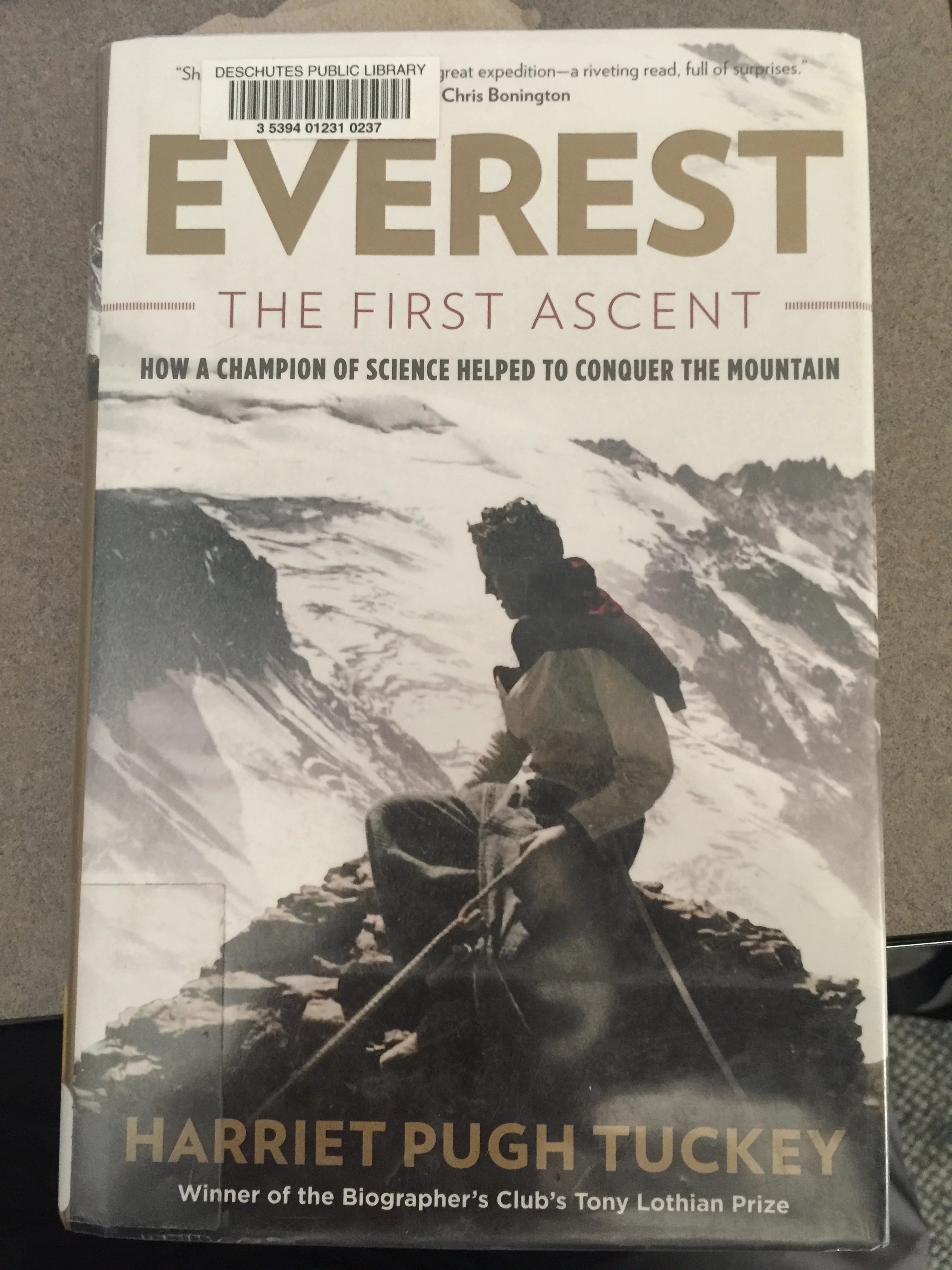
Today’s post is about risk.  I’ve been reading a really good book at about the first successful attempt at climbing Everest - “Everest: The First Ascent: How A Champion of Science Helped to Conquer the Mountain.”  There are many books about that first climb, but this one takes a different tack which I find interesting; it’s written by the daughter of the team’s chief scientist - a physiologist named Griffith Pugh.  As would befit a book from this perspective, a lot of the book covers the attitudes of the climbers towards science, and towards having a scientist with them.  Everest had been attempted many times previous to this climb, and they had all failed - of course - and failed in largely the same way; suffering from dehydration and altitude sickness, the climbers would retreat at or around 27,000 feet.  All of these climbs - the British ones at least - were arranged by the Alpine Club, which was an amateur climbing and mountaineering organization.  That group had the attitude we often find among amateurs: do your best, give it your all, and whatever happens, happens.  But for the climb in 1953, the prevailing political winds had pushed against this attitude.  It was commonly felt that the other nations, such as Italy at Switzerland, which had been getting more and more interested in the climb, would succeed in ’54 or ’55.  They had no compunctions against using modern equipment and science, and so the British were pressured into accepting things such as the use of oxygen, and special climbing tents and equipment.  And Griffith found himself right in the middle of this.  One page of the book in particular captured this situation well, and I’ll just quote it largely verbatim:


“The Alpine Club, with its amateur sporting ideals, was less well disposed toward science.  As…onetime club president Leslie Stephen told members in 1924: ‘True alpine travelers loved the mountains for their own sake and considered scientific intruders…to be a simple nuisance’.  By the 1930s an influential contingent had become convinced that the huge size and mixed objectives [mountaineering and science] of the early Everest expeditions, with all the scientists and their equipment, were largely to blame for the repeated failures…In the mid 1930s [this] Alpine Club view gained the ascendancy, fiercely advocated by iconic Everest veterans…The Royal Geographic Society’s scientific aspirations were set aside; the juggernaut missions of the past were supplanted by small, flexible expeditions far more enjoyable for the climbers and more consistent with their sporting principles.  After World War II, the ideas…that only climbers could understand the needs of other climbers, and that small casual expeditions were the only type worth going on - remained articles of faith…in perfect harmony with the public-school sporting ethos of ‘untutored brilliance’, the so-called ‘Corinthian Spirit’ by which gentlemen sportsmen achieved effortless success without really trying.  Only the mundane professional - an altogether lower order of person - would stoop to engage in elaborate preparations and heavy training, or feel the need for scientific advice.” (emphasis added)


I have always been a sportsman and a competitor, a sort of “weekend warrior”.  I enjoy competition and sports; I played a lot of sports when I was a kid, and as an adult, I’ve been a marathoner, a climber, a soccer player, and a distance cyclist.  There’s lots of reasons that I do these things, some of which have nothing to do with sports per se; the feeling of motion, being in better shape, meeting new people, visiting new places.  Putting all of those things aside for the moment, though, I find myself really interested in the competition side of it.  By which I mean not necessarily competition against others, but rather competition against oneself, or against nature.  In one of my Outdoor Leadership classes, we’ve talked about “risk equilibrium”.  This is the notion, among sports psychologists, that we as humans seek to maintain a specific level of risk.  If we encounter too much risk, we pull back.  Intriguingly, though, if we encounter too *little* risk, we search for ways to add in more.  For example, studies that attempt to isolate the effect of safety equipment often have the problem that people who wear safety gear - because they feel safe - do more dangerous things.  I find this idea of “Corinthian Spirit”, and the idea of “risk equilibrium”, very interesting in more personal life and my approach to sport.  

As with many human endeavors, sport and risk are things that happen on a continuum, and sometimes where we put ourselves on that continuum doesn’t make any sense.  For example, on the one hand, we could have people try to climb mountains with nothing but their bare feet and a few scraps of clothing.  That would be pretty ridiculous.  We could also just helicopter people up to the top and drop them off there.  Equally silly.  Somewhere in between, we accept a certain amount of equipment and help as “acceptable”.  We allow people to use canisters of oxygen, at least above a certain elevation.  We use camp stoves to heat ice and make water.  But we don’t use that same propane to power an engine to power us up to the top.  We allow poles made of carbon fiber and jackets made out of complex synthetics, but we don’t allow someone to be carried up the mountain.  I recently watched a video about a man with cerebral palsy who climbed Mt. Kilimajaro and they made a big deal out of the fact that one of his sherpas had to assist him up a couple of the more technical sections of one of the shear rock faces.  It’s not even clear - even to mountaineers themselves - what exactly the “rules” are.  It seems that it has something to do with lifting and moving yourself using only your own power - but clearly some assistive devices are allowed, such as really good shoes.  Clearly we have an advantage over climbers from the 1950s - who themselves had an advantage over climbers of the 1920s.  But, somehow, there is a human need to carefully avoid having an *unsporting* advantage.

And we still do this today - the rules about doping or drafting in cycling, for example.  The best example may be golf, which has elaborate books full of detailed rules about the specific kinds of balls and clubs that are allowed.  Golfers, for example, are not allowed to use GPS devices to tell how far they are from the pin - but they are allowed to employ caddies who walk the courses and memorize - yes, memorize - how far it is (using a GPS as their guide of course) from each major spot in every hole back to the flag.  

One of the things that always amuses me about sport is the idea of trying to explain the internal logic of these rules to an alien.  Imagine trying to explain to someone with no knowledge of human physiology or psychology why we’re allowed to ask a caddie how far it is to a pin but not a GPS.  Or why you can have someone follow you on a motorcycle and hand you water in the Tour de France but you can’t ride too close to another cyclist.

Comment

Comment

Day 249 - Bend, OR

People tell me that one of the things they like about my blog is that I am willing to be vulnerable; I don’t shy away from delicate topics.  I appreciate that, because obviously it’s hard to be open in such a public forum.  I’ve gotten some blowback in my personal life about some of the things I’ve posted, but I really try hard to “keep it real”, because otherwise what the heck is the point?

Along those lines, I want to talk about a personal issue that I have a feeling is shared by others.  I am afraid of people.  Not necessarily those I know well - although sometimes that too - and not strangers, per se, or large groups of people.  My fear is those people that I have some kind of interaction with but no basis for a trust relationship.  Service providers, coworkers sometimes, classmates, anyone I come in contact with on some sort of regular-but-not-too-regular basis.  Some would call this “social anxiety”, and I think that’s as good a word as any, although I’m not a psychiatrist so don’t hold me to it.

Some examples: about a week ago I made the decision that I would move out of my current living arrangement and head back to San Francisco.  I don’t have the best relationship with my roommates; its not a bad relationship, but it’s an awkward one.  They wanted me to be good friends with them but we’re more just housemates.  Anyway, I was really nervous about telling them I was moving out.  I have every legal, ethical and moral right to move out.  There’s really no reasonable reason for me to be actually apprehensive about telling them.  But I was.  Quite apprehensive.  It’s tempting to use a word other than “fear”, because that seems kind of dramatic - but it really is a fear response.  I can feel myself sweating just thinking about it.  And, in the end, they were minorly put out by it, a bit irritated when I did finally tell them.  But it will probably be OK, they’ll get over it.

Now, this may seem minor.  But it’s recently come to my attention just how much time and energy I waste on this issue.  Some people don’t have social anxiety.  Some, have social anxiety bad enough that they just avoid doing things.  They don’t move, they don’t change jobs, they keep life on an even keel.  Then there are people in the middle, who definitely find things like this nerve-wracking, but insist on doing them anyway.  And I am like a pathological edge case for this scenario; I crave new things, and I hardly ever let me social anxiety get in the way of my finding new things - but I have fairly bad social anxiety.  This is not a winning combination because it means that my life has the hallmarks of an extroverts’: lots of change, lots of new and sometimes amorphous relationships, plenty of acquaintances, an ever-shifting support structure.  But that doesn’t really suit my psyche.  It makes me nervous.  So, I spend a lot of time, well, nervous.  

I’m not sure what the answer to this conundrum is, if there even is one.  Obviously one answer is that I could settle down; stop moving, stop changing.  Someday, I suspect I *will* do this.  But that time has not yet come.  Another tempting platitude is to “just chill out”.  But I don’t think that works.  I can no more control my anxiety response to unusual or unfamiliar social situations than a person who has asthma can control their asphyxiation response.  Meditation and yoga and such help, which is why I do them.  But at the end of the day, I spend a lot of my time worrying about things.  One thing I can do - and do - is to increasingly try to find rhythm and routine even in non-routine circumstances.  Tiny habits that I can “take with me” and provide consistency.  Sometimes it’s as simple as keeping the same small list of possessions with me; the same phone, the same wallet and keys.  Sometimes that means eating at the same restaurants; I’ve filled out 2 different “frequent diner” cards for the same small taco stand here in Bend.  Sometimes it’s an exercise routine.

I love the new.  But, yeah, it stresses me out!

Comment

Comment

Day 246 - Bend, OR

image.jpg

I'm writing this blog post from inside the ACSM Northwest chapter annual conference.  That's the American College of Sports Medicine, for those keeping score at home.  We just heard a keynote by a famous researcher and scientist, Dr. Steven Blair google him).  The crux of his talk - and I'm drastically oversimplifying of course - was that we've spent so much time and energy on diet in this country as the way to prevent obesity, when in fact the science shows that exercise is much more effective.  Now, I can't honestly claim that I know enough to know whether what he's saying is true.  He's got a lot of science to back up his claims, that's for sure - and a sterling reputation.  All I can really add to the discussion is my own personal experience, which is this: I have, in my life, had periods where I cared very much about my nutrition.  I have denied myself food, denied myself processed foods.  I've also had times when I just let myself go. And the same is true for exercise: at times in my life, I've been an exercise fiend, and at other times, I've been a slob.  And for me, personally, the answer is startlingly clear: my body doesn't care what I eat.  It responds almost exclusively to two things: my exercise level, and my stress level.  When I am stressed and sedentary, I feel lousy.  When I work out and chill out, I get fit.  End of story.

When I focus on diet, it feels so negative.  It's all about what I can't do, and what I'm denying myself. I've tried all kinds of different diets, many of which were specifically designed to keep me from feeling like I'm denying myself anything, and none of them work.  They all feel like a prison.  Conversely, exercise makes me feel amazing - capable, full of motion and energy and possibilities.  It's all about what I can do, and what I can accomplish.  Diets stress me out.  Exercise calms me down.

And yet - as Dr. Blair showed - we spend so much more time in this country on diet than we do on exercise.  He did a simple search of fitness and obesity on the web and found about a million hits.  Diet and obesity?  70 million hits.  Similarly, he searched PubMed for scholarly articles.  Fitness and obesity was about 2500 articles, while diet and obesity was over 45,000.

The plain and simple fact is that the most healthy I have ever felt was on my bike trip last summer, when I rode my bike an average of 55-60 miles a day and regularly ate whatever the hell I felt like: McDonalds, candy bars, and yes, fruits and veggies as well.

Am I suggesting that a diet of McDs and candy is a good way to live life?  No, absolutely not.  There's a baseline of nutritional awareness that you must have.  But when it comes to feeling alive, capable and full of energy, that has so much more to do with how I choose to spend my time than what I put in my mouth.


Comment

Comment

Day 238 - Umpqua National Park, OR

image.jpg


Today’s post is ostensibly about climbing a mountain.  But really, it’s about death.  And not a metaphorical mountain, but an actual mountain.  Specifically, Mt. Thielsen, about 9200’.  And not metaphorical death - the actual no-longer-alive kind.  The interesting thing about this particular mountain is that today, I climbed it.  All the way to the top.  Well, OK, not quite - I stopped about 20 feet from the top on “Chicken Ridge”, so named because you literally must value your life about as much as a chicken to try the last part without ropes and pitons, which I did not have.  Actually, scratch that: chickens are pretty smart.  They wouldn’t do it either.

I did 3 smart things climbing this mountain:

1) I let somebody (my parents) know where I was going and to get help if I didn’t call.

2) I carried several redundant GPS systems and a fully charged phone

3) I did not climb past “Chicken Ridge”.

Then, I did 3 stupid things:

1) I didn’t carry enough water.

2) I went by myself.

3) I overestimated my own abilities.

One of these 3 things almost got me killed.  Want to guess which one?  If you guessed #3 - you’re a winner!  So, it turns out that there are two important things about climbing: one, when people who know what they’re doing tell you do something, you should do it, and two, climbing up is actually way easier (on a technical level) than going back down.  So, when they said “you should carry an ice axe”, I thought to myself “it’s unseasonably warm and not that icy; surely i won’t need it to climb”.  Well, duh - you need the ice axe to *get back down*.

As I plummeted down the side of Mt. Thielsen, uncontrollably cascading towards a pile of jagged rocks, these two facts became manifestly obvious.

Fortunately, I had listened just enough to just smart enough people, and I did have a set of what are called “microspikes” on my shoes (think golf cleats, but a bit more so).  With the frantic power that only people who realize they are in grave danger possess, I dug those sons of bitches into the snowpack as hard as I could and clutched at rocks as they flew by.  And slowly, surely, I stopped.  I had slid about 100 feet.  As I lay there, panting, I realized something: this isn’t over.  This is going to happen again.  And, sure enough, it almost immediately did.  This time, I stopped it faster - maybe 30 feet down.  But I realized something: I am screwed.  I don’t know what I’m doing, and it’s about 800 or 900 feet down to the place where the snow started to level out.  The snow is at about a 50 or 55 degree angle and every time I try to stand up, I just start sliding.  So, after quickly going through all 5 stages of acceptance, I realized the obvious: I’m going to have to slide.  And I did.  And it was terrifying.  I figured out how to do a barely controlled slide for about 5 to 10 feet at a time.  I was lucky: the snow was soft, and when it started to pile up under my butt, it would stop me.  I was doubly lucky: this could have been avalanche conditions, and here I am dislodging big chunks of snow.  I could watch bits about as big as my fist cascade down the hill in front of me, all the way to the bottom.  It took me about an hour - maybe more - to get down that 800 feet.

Was I ever in danger of actually dying?  No, probably not - at least not at first.  Fortunately Mt. Thielsen doesn’t have any big cliffs to go over.  But I easily could have hit a rock and ended up with a broken leg, alone, at 8700 feet above sea level (with no water).  I had visions of myself, broken fibula or wrist, trying to use my cell to call for help (fortunately, it was charged, and actually, you get service, because it’s so clear that radio signals travel).  

So, yes - I am officially an idiot.

It’s a funny thing about life.  I value mine quite highly, and yet, to be honest, some part of me knew that what I was doing today was a bit stupid.  Mind you, I didn’t know how stupid it really was, but the point is, I *knew* it was safer to just sit on my couch and watch documentaries about people climbing mountains.  But I didn’t do that.  Why?  I believe we’re the only species that intentionally puts ourselves in harms way for anything other than food or procreation.  That’s probably not 100% true actually, but still: you don’t see bears climbing mountains just because they’re tired of, you know, eating fish and having bear sex.  I think there’s something about us, as humans, that recognizes that if you have no chance of death, then really, you don’t value life the same way.

But next time, I’m bringing an ice axe and a friend.  

image.jpg

Comment

Comment

Day 237 - Bend, OR

painting.jpg

Today’s blog post is ostensibly about painting.  But really, it’s about positivity.

This semester, at COCC, I decided to take a couple of art classes.  One of those classes sounded really interesting; it was about color, and the use of color in design.  I, of course, was thinking about color theory as it applied to things like apps, games, maybe even movies - digital art.  But what the class actually turned out to be was a basic education in traditional color for painting.  So, we paint.  I’ve never painted, at least not since I was 8 years old.  So for me, it’s been about 10% color theory, and about 90% learning to paint.  And it’s a very humbling experience.  A lot of things I thought I knew cold have been really opened up to me.  For example, it’s been just a fact for most of my life that the three primary colors are Red, Green and Blue.  But not in the world of painting; it’s Red, Blue and Yellow.  And, it turns out, there are some really good reasons for this, which I won’t get into here.

Anyway, it’s been a really interesting learning experience, but also very humbling - which is where we get to the real point of the post.  Over the years, I’ve done some teaching and tutoring in math, and one of the things you hear over and over again is that people are scared of math, or feel like they can never succeed at math.  And often, what I’ve heard and read is that this can be because of negative messages from people around them.  This is something I understood, intellectually, but I never really related to on an emotional level.  Now, I do.

I am not very good at painting.  That’s OK; can’t be good at everything.  But my art instructor, Mrs. Platt, takes great pains to point this out.  Now, I don’t think she’s a bad person.  I don’t think she’s doing this on purpose.  If I did, I would have dropped the class.  I think that’s just how she relates to people.  When I bring up my work to show it to her, the first thing out of her mouth - every time - is something critical or negative.  I think she realizes this, because outside of class i’ve gotten a few emails from her that are really positive, as if she’s trying to compensate.  She even sort of half-apologized for it once during class.  She’s not negative to everybody; some of the students are quite good at painting.  But she’s very forthright and honest - and honestly, I’m not good.

And it is profoundly disheartening.

Now, I fight through it, because I’m 37 and not 17.  But replace painting with math, and replace me with one of my former tutees or students, and I can really see how having somebody just be honest - not mean, but honest - can be really demotivating.  You feel like you’ll always suck, like it’s just not worth trying.

In my life, I have not been a very positive person.  To put it lightly.  When I was younger, my attitude towards this was “suck it”.  This is who I am - I would say, or think - and if you don’t like it, tough.  Can’t take the heat, get out of the kitchen.  That sort of thing.  As I got older, I realized that approach was hurtful, but I still never really figured out how to deal with my own feelings in a way that felt genuine.  So my approach as an adult has been to hide.  In situations where I feel negative, I try to clam up, or walk away, or say something noncommittal.  And I do think this is better than just blurting out whatever’s on my mind.  But it’s only a half step.  I realize that one of the great challenges of the back half-to-two-thirds of my life is going to be finding a way to be genuinely positive about other people and their talents and abilities.  Genuinely positive.  Not fake, but really capable of seeing the potential in other people.  That’s a challenge for me; it isn’t really how I was raised or taught.  But it’s the way I want to be, because I want to encourage others.  Or at least avoid discouraging them!

Comment